
There are a few nascent dory designers who have written to me with comments and questions about designing and
building Mistral, so I’d like to talk about that in a little more detail, hopefully answering some of those questions. (The rest of you, please humor me…)

There are no plans on paper for the build of this boat -- I think you can get by just fine without true plans, because the dory is a simple boat that has changed very little in centuries and is tried and true. And before there was paper, the plans filtered down through generations by word of mouth and trial and error.
I think of wood boat building as sculpture. Each piece made in the process has to fit in complete harmony with every other piece, so it's essential to visualize the entire piece from the very start. Wood carvers will tell you that the material they are using defines the sculpture. Despite the mathematical rigor in boat design, every hand made boat is different from all others, even those made by the same person with detailed plans, since interpretation plays an essential part of the creation.
For me the design / build process is organic and develops in my head as the boat is built. The proportions of dories can be found in a variety of sources, but the boats are remarkably similar. For this reason I was confident, though I had never seen a dory as big as
Mistral, the proportions from an existing table of offsets for a banks dory would translate smoothly into the much larger boat I imagined.
If you are drawing your own plans and feel intimidated about details, take heart! Jump right in, the details will work themselves out.
I don’t mean to imply that the boat built itself. There was a year of pondering and engineering to work out the scantlings and when in doubt, I erred on the side of overbuilding.
Mistral utilizes modern truss framing and plywood for strength so, though she is a stout boat, she still required additional ballast to carry sail.
The backbone is a keel built of laminated fir 2x6. For the forward half of the boat, this keel takes the shape of the rocker, but for the aft half, it has a flat bottom combined with rocker and so becomes deeper toward the transom.
How much rocker is needed? There is the
St.Pierre et Miquelon which has a very jaunty chine and even livelier shear, and is an active boat, buoyant and agile, thus so the Mackenzie River Dory, which can turn on a wave crest. The bateau or flat bottom skiff has almost no rocker and is less fidgety. The eventual use will determine how active the bottom shape of your dory will be.
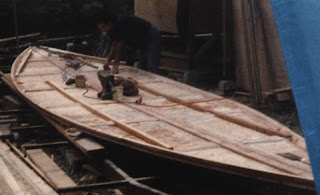 Mistral
 has about six inches of rocker fore and aft, and is relatively flat for boat with a 30-foot waterline. It’s just enough, and she cuts through the water like an eel.
She has straight frames with sheet plywood and was originally designed with a 3/4-inch bottom, 1/2-inch hull, 1/4-inch cabin sides and 3/8-inch decks (all marine grade fir plywood). The frames are (clear grained) old growth Douglas Fir 2x4's at 17 inches center to center. I didn't feel comfortable with the 3/4" bottom, so laminated another layer of 3/4" for a total of 1.5". I would recommend this, since the weight down low is good for stability, and a flat bottomed dory should be able to support it’s own dry weight.


Since
Mistral is to carry sail, she needs ballast. The ballast is in a box, made of half-inch plywood, poured full of concrete, with several continuous lengths of steel reinforcing bar, for structural integrity. The ballast keel weighs one ton and is aligned with the middle section of the boat, which, for a double-ended hull is the approximate center of resistance. The finished keel is 18” deep, which gives the dory a total draft of 2.5 feet.
Stainless threaded rod bolts the ballast to the wood keel and epoxy impregnated 10-oz. fiberglass cloth covers the keel and hull. The motor is mounted off center, so there was no need to install a shaft through the keel. The weight built into the bottom vastly improves the handling of the dory.
 Mistral
 has an 11-foot extreme beam, which means that on the road, I need a wide load permit and occasionally, pilot cars. Fortunately I don't trailer her much! She weighs five tons and about two tons of that is ballast. I added (one ton) interior ballast with the new mast, because she was very tender.
The dory is a very buoyant boat by nature and rolls quickly from side to side, which makes people nervous. Once you know the boat, this feeling disappears, because the design is incredibly seaworthy and will always right itself. You learn quickly to keep your weight centered. The hull will carry an impressive load --- an additional ton of ballast raised my waterline only 1.5"!
Mistral has "raised decks". In the pictures, the knuckle you see is the true shear and the beam of that basic hull is 10 feet. There is added width in the raised decks (an additional foot), which I designed primarily to help give me standing headroom without having a tall, boxy cabin. This feature became apparent during construction and is an example of how a plan will develop.
The beam at waterline is approximately six feet, which is a positive influence on efficiency, but contributes to lively response.
With
Mistral’s low aspect sail, she goes like a greyhound on a reach or downwind, but with a full keel, she is slow to tack.
I run a 9.9 hp Mercury four-stroke “Sail Power” outboard in a motor well, which pushes the boat along at about five knots and is a testament to the efficiency of the double-ended dory hull. This oversized dory will cruise at this speed for 7-8 hours on a small three-gallon tank of fuel, with this small efficient motor.
A full sea trial is still in the future. I intend to petition my friends as crew. Any takers?
The mainsail I ordered for
Mistral is still at the sailmaker's - I think I hit her at a bad time of year. So, I'm still using an old hand down main, which is too small for the boat. I recently adapted a used jib (Lashed on some hanks – That was fun!) which seems to work just fine (the one I had is now the storm jib). So things are improving. I made an up river run from the boat yard last week under jib alone (running with the tide) and averaged five knots! There was too much stuff (paint cans and etc.) to get the main out.

There is a great book about building the St.Pierre et Miquelon by Mark White, published in 1978 by International Marine Publishing. It is probably long out of print, but a real jewel. Mark builds a planked St. Pierre in Alaska (outside!) and documents it with pictures and a text intended for commercial fishing vessels. He recommends a 10 hp Saab or 10 hp Volvo Penta. He says the Saab has more torque, but the Volvo is much more economical.
To carry the weight of the inboard, Mark widened the transom eight inches, top and bottom, then fared that extra width forward to just past amidships. This added buoyancy and stability in the stern.
I wish I had widened my transom a little, too. I love the double-enders, but the cockpit is narrow just where I need the room for jib sheets, main sheet traveler and such. With the motor well in the cockpit, my big boat has the working room of a much smaller vessel.

There are design changes going on in my head all the time. If I were to build this boat again, it would look much different. But I won’t bore you today.
Please check links to other posts detailing the
build of Mistral for additional information.
I’d be interested in hearing from others who are designing their own boats. The process involved is similar for all types of vessels and we can share comments and feedback.


