
The voyage ethereal continues apace...
When this weblog was introduced, I didn’t
really know where to take it. Then, I found the beautifully functional designs
of Iain Oughtred! Web searches turned up little, so I decided to profile some of
his work here. Those who have been around for a while may remember what
blossomed into profiles of small boats of all kinds, with emphasis on
home-builders and their creations. Today, the Internet is awash with gunkholing
vessels of many types and documentation of their creation. The community I once
envisioned has arrived and I am so happy to be part of it. After forty years as
a wood boat builder and builder’s advocate in the workspace, I’ve passed on the
baton.

Make no mistake, I continue to sail and have a few projects languishing
here and there, as health allows. For now, I have exciting news. From the days
when I first learned to sail, my experience was with small wooden keel boats.
Then came the Gougeon Brothers with their plywood and glue methods,
revolutionizing home boatbuilding forever.
While I’ve embraced new materials and
methods, my heart still lies with hand-built vessels made of living trees. To be
sure, although some are still being built, the planked wooden boats of yore are
an anachronism today. I’ve lived and breathed this transition, so in some ways,
I suppose that makes me anachronistic, too. So be it.

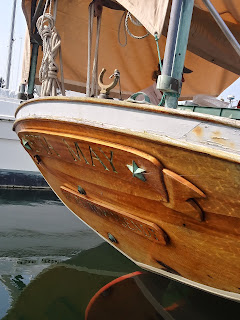
Enter Etta May, a
Friendship sloop built in 1960. Carvel planked cedar on oak frames, it doesn’t
get much more traditional than that. She’s 27 feet LOD (on-deck) with a 6 foot
extreme beam and 32 feet over-all She has a short spruce mast, supporting a gaff
rigged mainsail, running backstays and all. I could be twenty years old again!
Various sized jibs (hanked-on) and spinnakers complete the rig.

Auxilary power
is a small diesel motor, but you know how Doryman feels about motors of all
kinds.
Please note the mount for a sculling oar.
A realistic survey of this 63 year old shows her age. We may be on our last dance, who knows? All I can tell you is, I’m happy to be here.

A new/old
chapter in the Voyage Ethereal.

New Skipper.

The only gaff rig in the bunch.
Isn't she beautiful?


