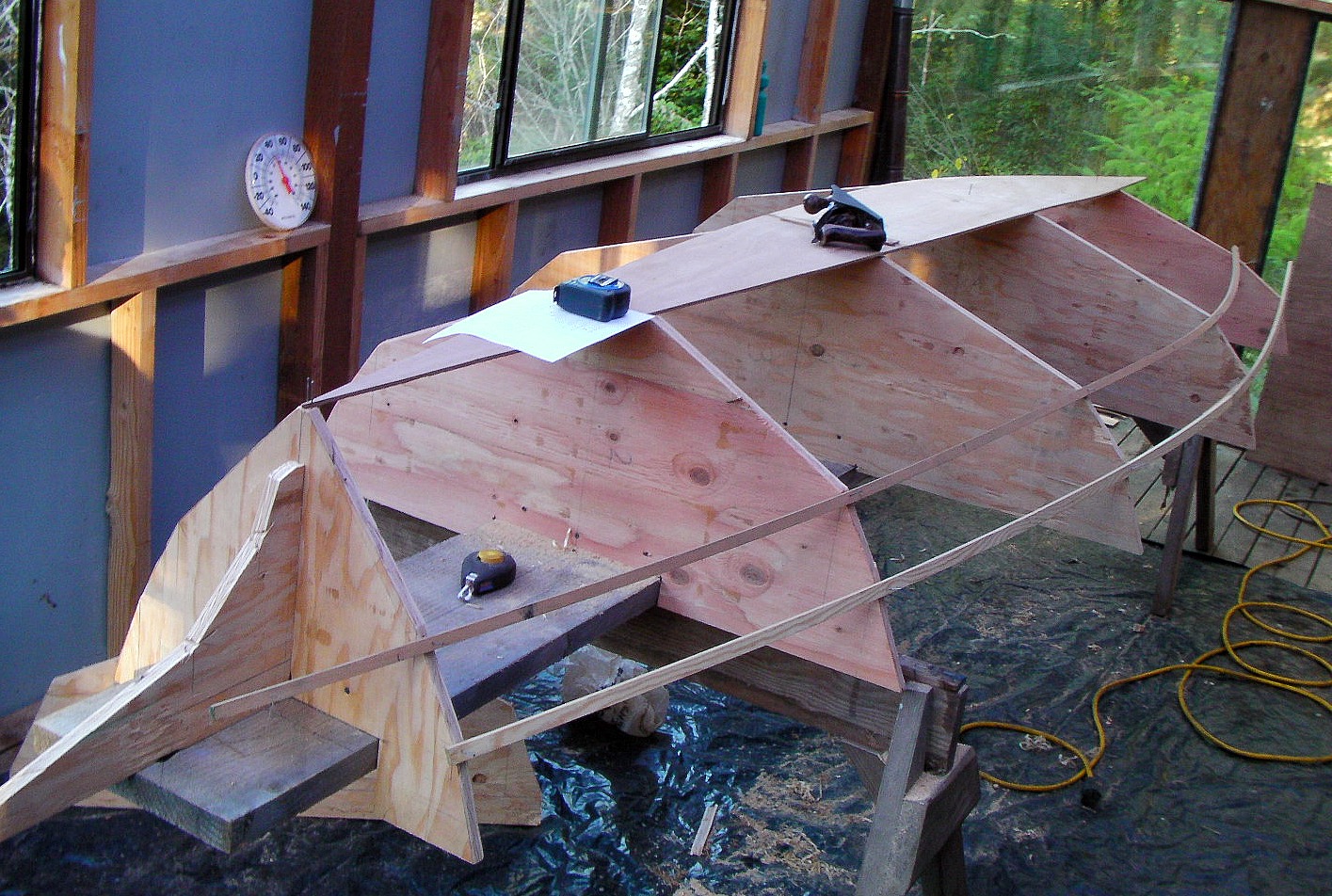
Winter temperatures here on the Oregon coast have been uncharacteristically cold recently. Nothing slows boat building as much as cold temperatures. Although, those who are familiar with Doryman know, the design process never stops.
I've been fitting the decks on the melonseed (finally). For a few weeks, the process of putting finishes on the interior was a test of patience. You all know I'm not famous for having patience. But it had to be done. Some compartments are impossible to finish once the decks are on, in fact finishing the inside of a boat is much easier all-around before the decks are laid. There once was a day when I would impatiently power through the building process and leave the finishes to the end, which is self-defeating, to put it succinctly.
Waiting for paint and adhesives to dry is a good time to review and update designs. Then you can always say you are working, even though it looks like you are watching the paint dry.
Sometimes an idea that has been incubating for a long time suddenly seems to augment. Such is the case with this melonseed. You may remember, the modern recreational melonseed is an adaptation from the Jersey Skiff, an east coast of North America duck hunting boat of the nineteenth century. It has proven to be an adaptable and seaworthy design.
The Boat Bits web-log recently brought to my attention a coastal cruising design from Gilles Montaubin, L'Etroit Mousquetaire. Please note the similarities in the hull shape between my melonseed and this attractive minimalist cruiser.
Quite a coincidence? Perhaps, but more likely it's just one of those ideas that works. The coincidence is that for the last few months, I have imagined my little sailing dinghy as a larger boat with a cuddy cabin. And here it is, from the pen of Monsieur Montaubin!
I'm going to step right out on the limb now and say... why build one of the recently popular slab-sided cruisers when, for the same money and effort you can have a simple, elegant design like this?
It's been a bit chaotic around here, something that is not suppose to happen for two more months. The malignant winter weather has turned unpredictable. What is worse, knowing the weather is against you, or wondering if it is?
Progress has been made on the Doryman Melonseed, however. The boat is now turned upside down to install a fixed keel.
You heard right, a fixed keel.
The plans still call for a centerboard, but when I looked at the open interior of this gunkholer, it was too pristine to spoil. We'll see how this works, and if it does, so much better. Imagine a nine foot long unobstructed cockpit in a sixteen foot boat. A melonseed should draw about 4-5 inches and is meant to traverse very shallow water in a river delta. This boat will draft close to one foot, so floating in marsh grass is not on the agenda, but most days, one foot of draft is good, in fact, very good.
This new design prototype was last winter's indoor project and will be continued in a few months. With all the boats shuffling around out in the boatyard, an empty trailer happened to be standing by.
I called Brandon, asking if he would like to help me float test the unfinished boat... barely got the words out of my mouth...
Brandon refers to Beaver Creek, where it empties into the Pacific Ocean as the Beaver Creek Test Facility. It's only a couple miles down the road, has a very nice, little used small boat ramp and is sheltered from the ocean winds. Two winters ago we tested my rowing shell there and you all know how memorable that was, as Doryman took a dunking.
This Melonseed is a new design but is not experimental. The Jersey Skiff duck hunting boat has been around for a long time. In fact Howard Chapelle drew lines for his famous Melonseed half a century ago and kicked off a whole new generation of duck boats as racing skiffs. Many modern designers have recreated this boat. It has been built carvel planked, lapstrake, strip planked, stitch-and-glue and cold-molded.
But never before has it been conceived in the wide seven plank method of the old Norse, until now.
The bottom is a flat wherry keel, symmetrically double-ended and about a
foot wide amidships. The next plank is wide and brings the hull up past
the waterline. The wherry bottom and the garboard panels are joined
with a flush-matched chine. The topsides are comprised of two planks which are lapped, clinker style.
It seemed wise to give the hull a test before finishing off the decks and I wish to report, this is one very fine boat. It moves very efficiently, tracks well and has plenty of reserve buoyancy. Brandon and I each made a test run and made notes about relative trim as we moved weight fore and aft. With no ballast and only one person, the boat was very stable. As you can see from the video, just a light pull from a paddle moves her right along. Brandon had to move to the fore of the cockpit to get the bow to sink, which means there is plenty of fullness forward that will come in handy while sailing.
Right now, there is a lot going on in the boatyard, but as the winter monsoons come on, it will be back to work on the Doryman Melonseed. Can't wait to sail this little skiff. I'm working out the final details for new plans so if you think you'd like to build one of these, please, send me a note.
Here's a quick video that might help with your decision:
In the upper left corner of this page is a search window. If you type in Doryman's Melonseed design, you will find, as I did, that this project started in December of 2011. How could that be? Four and a half years. Well, I guess you know how fate has befallen this sailor.
Take heart my patient reader, for the long awaited sail-rig has evolved to the test stage. We already know how Aria rows. Like a song.
Martin and I chose a calm day for our first sail. Turned out to be breathless, but we had enough puffs to get a feel for how this 'seed flies.
It was apparent from the first, the free-footed sail needs a boom for windward work. The fixed keel shape, taken from Atkin's Valgerda allowed quite a bit of leeway, but I think that will improve with a boom as well. I intend to leave the foot loose, lash the sail to the boom at the tack and clew and use a downhaul from the clew to the base of the mast.
If this sounds confusing, we'll come back soon with photos and an updated report.
We've had a very mild fall with little rain, which is a bonus if your livelihood is maintaining and building wood boats. Recently, however, the weather has not been so nice and Doryman wishes he'd spent more time on his woodpile.
When weather threatens around here, we retreat to the back porch for boat work, which is at least dry, if not heated. Then, each day is gauged by the barometer and the dewpoint. It's a little known fact that epoxy is not nearly as sensitive to temperature, as moisture. I don't mean to be confusing here, epoxy does not give a fig about moisture. But wood does. It's this simple - if the wood is saturated with moisture, it will not accept epoxy. But if there are ten degrees (F) of separation between the current temperature and the dewpoint, and your wood is not actually wet or green, the epoxy will penetrate and adhere to the wood. The shop-vac is useful for "air-drying" wood surfaces, though a hair-dryer works wonders. If last night was cold and today it will rain, try blowing your wood surfaces with a fan or a shop-vac exhaust before applying epoxy.
If the conditions are wetter still, which might seem extreme, though we spend four to five months a year around here with 100% humidity - so we understand - a very good substitute for epoxy is a polyurethane glue that is formulated to cure in the presence of moisture. Which is why you see a black adhesive in some applications, in the construction photos. Another excuse for using polyurethane glue is probable movement. Epoxy has much more tensile strength than wood, so will fracture and de-laminate where wood flexes, swells or shrinks. In those cases, a more flexible bond is required. I bond all my plank laps with polyurethane glue, because my boats are built to be outside, in use, all year-round.
To date, the Doryman melonseed has been planked and framed for decking. The most recent step has been the installation of anti-skid strips milled from Oregon white oak. Aside from helping to keep traction, they act as stringers which add stiffness to the wide garboard plank.
One day we may take some time to talk about the design process. This particular design is informed by Howard Chapelle, William Atkins and Uffa Fox.
In other Doryman Boatyard news, the mast for the Teak Lady, Che Hon is being repaired. This 73-year-old old Douglas fir mast was cut off at one time, just above deck level, with the intention of installing a tabernacle, but we've decided to restore the boat to as-built condition. A foot above the old cut, the mast was hollow so in order to scarph three feet onto the existing mast, a plug was fashioned to fill the void.
The mast is 3 1/2" in diameter and the scarph is 12/1.
As a result, the mast will be much stiffer, higher up from the deck, which will affect it's bending characteristics. This might promote failure, if the boat were sailed to it's potential, but it's not likely Che Hon will ever campaign another race, she's retired.
Sounds a lot like the tired old sailor typing this missive...
This winter's indoor project is a Melonseed Skiff, an adaptation of an old hunting design from the Delaware River Basin, on the eastern seaboard of the US.
One of the first modern reproductions of this 1880's New Jersey gunning skiff was drawn by Howard Chapelle. The design proved to be a favorite daysailer and has been praised by contemporary sailors as a responsive sailing performer, handy under oars, and just plain beautiful.
Today there are many techniques that can be applied to building these fine boats; stitch and glue, clinker (lapstrake), strip plank, cold-molding, and traditional carvel cedar planks.
This boat will have seven planks, a combination that, to my knowledge, has not been done before. The bottom is a flat wherry keel, symmetrically double-ended and about a foot wide amidships. The next plank is wide and brings the hull up to the waterline. The wherry bottom and the garboard planks will be joined with a flush-matched chine. The topsides are comprised of two planks which will be lapped, clinker style. The finished boat will be half-decked, because with less than a foot of freeboard, there is a risk of swamping under sail. This low, sweeping shear profile is one of the Melonseed's most attractive features.
The most common sail rig found on a modern Melonseed is a simple sprit-boom, stepped far forward. Because many of these boats are approximately 13.5 feet long, the sail is small. The rig is designed to strike and stow in the boat for rowing and duck hunting.
To adapt this boat for gunkholing or a RAID, I have lengthened it two feet and maintained the same proportions. The resulting boat is perhaps 40% larger than a Jersey Skiff of the 19th century. Every effort will be employed to keep this larger boat from becoming too heavy for one person to row. The hull is planked with 6mm marine plywood and shaped with a minimum of bulkheads. Lightweight spruce stringers will back the plank seams or laps as necessary.
The sail rig as shown in the plan employs a gaff yard with a boom. It is considerably larger than the old duck boats and should power this racy centerboarder like a thoroughbred. There are many rigging options for this little skiff, so this design may change. But the hull is already underway, so there is no turning back now.
Work is progressing slowly since the temperature outside (and on the back porch too) is above freezing only four hours a day. This is unusual for our northern Pacific coastal climate so I expect daytime temperatures to rise soon, when the rains come back. Still, it takes days for glue to dry and the sun sets way too early. Looking out the window at three in the afternoon, I could tell the sun was already near the horizon by it's low reflection on the alder trees in the backyard.
I'll keep plugging away and posting photos to my Flickr site when there is any significant progress, hopefully once a week.
She fits well on her second-hand trailer, pretty as a melonseed.
Thank you, Scott, Jason, Brandon and Ellie!
Ready for a sea trial as soon as a busy Doryman gets a free day. But what to name her? I'm stumped. Since she is a duck-hunting design, something along that line seems appropriate.
What do you think?...
A late afternoon fitting of the rigging.
So far, so good.
For a few days recently, the weather here on the Oregon coast was simply fabulous. But apparently the monsoons have returned and along with them, an under-the-weather Doryman. Not feeling too spry today.
The fine weather gave me the opportunity to cultivate the garden plot and dream of fresh vegetables. There are quite a few plants that wintered-over and spring seems to have a big head-start. Anyone who loves the sea and also enjoys raising a garden will instantly realise the conflict here.
Warm temperatures also facilitated putting finishing touches on the Doryman Melonseed. The roof of the porch where this boat is being built is made of a greenhouse material, so it's a joy to now sit in this solar heated space and contemplate the beauty of this little vessel.
Next the melonseed will need a trailer. When we launched this boat, just before the decks were installed, the trailer was from another boat. So, one more hurdle before true sea-trials, but I expect to discover this will be a great sail-and-oar boat. The thwarts are removable to maximize use of a nine foot-long cockpit. They are also spaced for two rowers, so an extra rowing station can be configured, if required.
Ready to head out the door.
The view during afternoon tea on the back porch. You would think I'm tired of this view, having looked at it for hours on end, but no.
Many thanks to those who offered advice in the design stages and encouragement with support along the way. Truly, this has been a community effort. I would especially like to thank Barry Long, Mike Wick, Dave Lucas, Brandon Ford, Jim Ballou, Marty Loken and most important of all, Mary McCall.
The end of January brought temperate weather to the Salish Sea, enough to tempt a groundhog out early. Which means activity in the Doryman boatyard. Some of you who have been around for a while may remember the Doryman Melonseed. Aria has been in the wings waiting for a sail rig. The plans call for a sprit rig but since I'm the designer, an easy administrative decision was made to substitute a balanced lug sail.
Why not simply make the sprit sail I sewed last winter into a lug sail? I think it will work. But not as easy as one might imagine.
Redesign in the works, on rainy days. Stay tuned.
Dryer days mean repairs on the Sam Crocker Stone Horse, Belle Starr. I met an interesting boatbuilder a few weeks back - a fellow older than me with a more traditional training - who insisted a Stone Horse has no chine. I said it's a Stone Horse redrawn from Sam's plans to accommodate plywood construction. He insisted the chine made it some other boat. Very interesting proposition.........
Belle Starr as she looked last September. A Hulk.
Sailing season over early. Not much chine left.
Demolition left very little of the starboard side. Paul looks despondent but he's really enjoying himself.
About a month later the "A" team closed up that gap and once again, a chine emerged.
Plywood construction methods show quick progress toward healing wounds, physical and psychological.
A couple very wet months suspended that initial push but just recently the clouds miraculously parted. The freshly faired Belle Starr emerges whole again. Gotta love that beautiful chine. I think Sam would approve.
These shots are from two days ago, after some intense sanding and fairing.
She's not finished by a long shot.
But it's a great relief to have gotten this far.
I believe this is one of Sam Crocker's drawings, but I'm not sure which boat. Looks suspiciously familiar though, doesn't it?
This was suppose to be a quiet winter with the focus being the design and build of a Melonseed Skiff. Sorry to say, not much has happened with the 'seed in the last two weeks, but that will be remedied soon.
The next phase is framing the decks which, as you all know, is not glamorous and very time consuming. To see the progress to date, visit Doryman's photos.
So what has Doryman been doing? Taking long naps in front of the fire, no doubt.
I have one word for you: Stone Horse. Well, that's two words. One fine boat.
The weather has not been cooperative and snow doesn't help, but work is progressing on the Stone Horse, Belle Starr.
The Sandman has been doing what he does best.
If this isn't the most boring video you have ever seen.......
The bowsprit and boomkin from this boat were made of Black Locust and left untreated. These pieces weathered and checked, but after thirty years were still hard as wood gets. Unfortunately they had "fastening sickness" where they had been mounted to the decks and needed to be replaced. The new sticks have been shaped from an African hardwood named Limbali, which is also very dense. They received a primer coat of paint today. The Limbali would varnish nicely, but a bright finish on a boomkin is for show boats.
We'll see some photos of those pieces as they are installed on the boat, later this month.
There is some rotten wood where the port cockpit deck meets the main bulkhead, which affected the bulkhead, the deck and the counter-top on the other side.
All the rot has been chiseled and chipped out, oh what a mess! I'll spare you photos - just take my word for it.
The Ken Basset Firefly, Finesse has been a design challenge. She took a new finish nicely but the oarlock outriggers have been another story. This boat came with a retired set of twelve foot Concept II carbon fiber oars rigged for a six foot wide outrigger beam.
These technical oars would be fun and fast, though a bit too much for a man of a certain age.
The marine facilities around here are designed for big boats and the docks float high as a necessity. Approaching such a dock with outriggers that double the beam of the boat is difficult, if not dangerous.
So, Finesse will be "detuned" and employ 8.5 foot long oars. The outriggers slide between hull and inwale, and are removable to make docking and rafting-up easier. Several design mock-ups have gone by the board in an effort to make something that fits all these criteria. The verdict is, the oarlock stanchions you see in this photo will be adequate, but not pretty and Finesse deserves better.
Doryman is fortunate to have good friends who make personal sacrifices for others.
I'm very happy to tell you that these fine people (you know who you are!) chipped in and paid for a new windshield and the old van is back on the road, somewhat worse for wear (a bit like its owner).
It's good to know you can count on your friends! I'm grateful as a man can be.