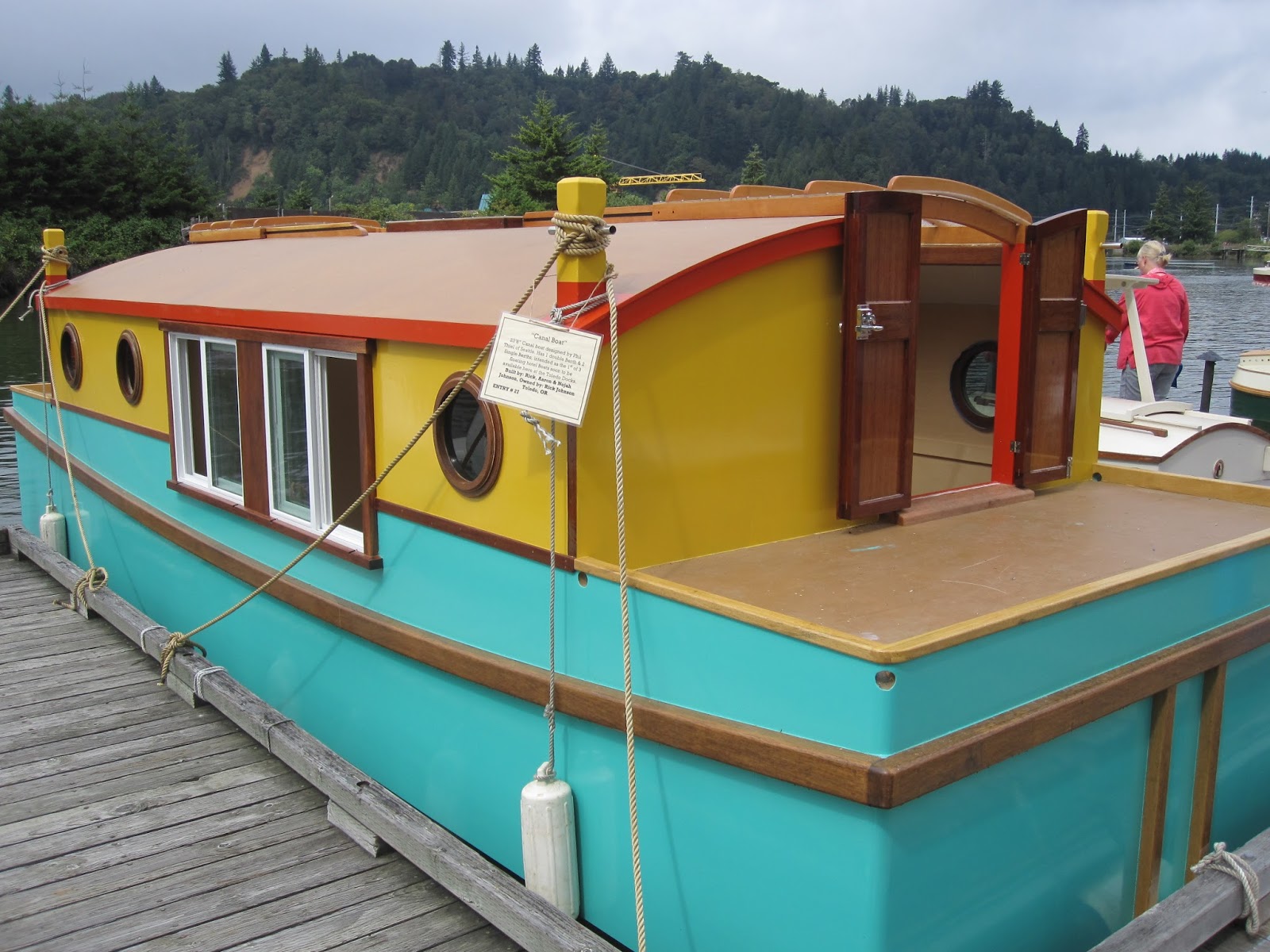
Whew! Just recovering from a long weekend at the annual boat show in my home port. This show happens every third weekend in August and it's always a lot of fun in the sun, on the water. Of course there are the boats, many of which were created by their owners. The live music is excellent, the food is very good, there are activities for kids, demonstrations of kayak skills and paper boat races. The last is completely insane. Toledo is a mill town and the paper used in making the boats is a water resistant packing material donated by the mill. The rest is up to the imagination. I'm afraid that to get the full effect, you have to visit the show.
My cruising dory, Mistral was in the thick of the action, at her usual mooring and I talked myself hoarse in three days, visiting friends from near and far. Our Teak Lady sailboats were in action, giving rides up and down the slough and the Toledo Community Boathouse provided rowing and paddling craft for free, to all comers.
I asked some friends to help take photos, which you can find on Doryman's Flickr site. You will recognise many boats from previous years as well as newcomers to the fleet (some of us just can't quit building).
Speaking of building, a real highlight of this show is the Family Boat Build. Starting on Friday, each group begins their boat, which was a kayak this year. By Sunday afternoon, the boats are launched and tested by the proud owners. This little fifteen foot kayak is so appealing, I'm going to build one myself. The hull is already begun. It will be the annual winter boat build, here on Doryman, so stay tuned
Well, I was waiting for this boat to be finished before unveiling it. But it's just taking too long! For anyone who's built a boat, you know what it means when I say I'm tired of looking at this thing!
At the right the boat side panels (a single plank) are laid out.
Other builders may disagree with me, I'm not the most scientific or mathematical builder. Most of the shape of the finished product is a subjective "how does it look?" process. (There is no substitute for the mathematical description from a plan, don't get me wrong - it can and will be internalised so it's not a conscious process, however.) Work for a couple days and take some pictures, pour yourself a drink and look hard. This view, that perspective. How will it sit in the water? Early on, the final paint scheme comes as an epiphany. So, though this boat has been a process (the plans were discarded long ago), the actual boat has been visible for quite some time.
This bateau began as the Peace Canoe as detailed by John C. Harris (owner of Chesapeake Light Craft) in Wooden Boat magazine, "Getting Started in Boats", issues #195 and 196, March through June 2007.
So, what I want to describe here is how a new boat design evolves. Often a designer will sit down with a set of parameters from a client (if the client is yourself, so much the better!) and brainstorm about what boats that are built that may be similar. In this case, the Peace Canoe was chosen for it's simplicity and functionality. It turned out that it was also an appealing and attractive vessel. (This may be a prototype for a boat show demonstration later this spring on beginning boat building techniques). The design is ages old and adapted from the old hunting and fishing pirogues. These simple boats have been used for duck hunting, fishing in the old slough, and even harvesting rice in the Old South. Similar to a dory (what a surprise!) the flat bottom allows for exploration in shallow back waters unnavigable by other deeper draft boats. The difference between a bateau or a pirogue and the dory types is the low freeboard and nearly flat bottom (the dory has a substantial rocker suited for cresting breaking seas). Thus, the bateau is a calm water boat, though don't imagine that she can't handle a little weather!
John Harris has this to say about his design: "Call it a canoe, a pirogue, a bateau, or whatever you like---the Peace Canoe is good basic transportation that you can build at home"
On the right, the side panels are attached to the stem and bent around a single "mold", it's that simple!
The plans for the Peace Canoe are for a double ended eighteen footer. I realized right away that I could save quite a bit of cash if the boat was made from two sheets of eight foot plywood, so the finished boat is 15'-8". In all, reducing the size saved a sheet and a half of marine grade mahogany plywood. All said, that translates to three and a half sheets instead of five. That's a thirty percent savings and with the price of marine grade material -- well, you get the idea!
So, the first design change is that instead of an eighteen foot boat, we have just under sixteen. All other dimensions need to be extrapolated to correspond to this new parameter.
The Peace Canoe was designed to use fir plywood and fir scantlings. With it's dramatic shear, the fir is bent to about it's maximum stress in the shear guards and chine logs. I decided early on that I would use mahogany plywood and I have some very nice Oboto mahogany from Africa that just begged to be used for shear guards, thwarts and chine logs. You might guess by now that the bateau will be finished bright.
The chine logs and shearguards are attached to the side panels or planks before they are stressed into shape. (In every other boat I've built those components are added to the boat in its formed shape). I found that since the mahogany is less supple than the specified fir, bending the panels was very difficult, in fact two of my carefully made splices broke during this process (a very frustrating event as you might imagine), so the second design change is that my bateau is six inches narrower than the Peace Canoe and, as you can see from the pictures, (a third design change) the double ender now has a tombstone transom (see picture above). These changes were dictated by the material used, a very, very old, time tested method of design/ build. At this point the boat we are building bears a significant departure from the original plans and can almost qualify as a new design of it's own.
After installing the thwarts, the boat is then turned over and the bottom traced, cut and fitted. Note that the center thwart is a sealed flotation chamber, another design change. The original plan called for solid foam glued to the underside of the thwart, but I can't bring myself to buy that stuff, it's showing up on every beach in the world!
From here on out, all bets are off. With abandon (this is the fun part!), finish details are adopted on the spot. Maybe that's why a boat that is advertised as a weekend build has taken a month! Right now I can't tell if it's the success I want it to be. (Disclaimer: It's never good enough! But I've learned to live with my fussy nature.) It's a good looking boat and will suit my needs as a tender for Mistral, but as for it's seaworthiness, or whether it will turn heads at the boat shows, only time will tell.
And you will be the first to know.
The (mostly) finished bateau. Thanks for visiting!
Time and again stories surface that distinguish the humble dory as a historically significant boat. A faithful reader named Michael contacted me recently to share his passion for these simple boats. It’s always good to hear stories of how well a dory has served its owner, often against odds. The setting for this story is the yet untamed wilderness of Alaska, in the 1970’s, when young adventurers arrived with dreams of becoming wealthy salmon fishermen.
Michael begins his tale:
“My first dory was by Grunwald of Aeolus Boatworks in Davenport, CA. It was built to the lines of the Higgins and Gifford Dory in Chappelle's American Small Sailing Craft.”
“I took it to Alaska on a boat trailer in 1972 and it's still there. A couple of youngsters made an extended camping trip in her a couple years ago but she's too far gone to be trustworthy now.”
“The plywood planks are lapped and are backed by full-length battens inside, very strong construction. I can't begin to describe how horribly I mistreated that boat in Alaska. It lived the life of a neglected livery boat most of the time. She also transported deer and packed water to a winter cabin. That dory enabled a safe subsistence lifestyle in a very remote place.”
“I used to row this dory on San Francisco Bay, often crossing at night. I picked up birds during an oil spill, in 1971. In 1972 I towed the boat on her trailer to Haines, Alaska then by ferry to Juneau, and then motored with a British Seagull engine to a small fishing village where I began my commercial fishing career.”
“After fishing the Gulf of Alaska for a couple years, I stashed the boat at a cabin on the outside coast and a trapper found her, enlarged the motor well to make room for a great big outboard, and then lost the boat.”
“I was in California at the time arranging financing to buy a commercial trolling boat when I got a call from the Coast Guard wanting to know if I was dead. It seems a Red Stack tug traversing the Fairweather Grounds with a double tow found the boat sunk and drifting. The skipper made a circle of a mile diameter and picked up the boat, taking her to Seattle, where I found her and arranged for passage back to SE Alaska on the deck of a tender.”
This hard working and long lived Higgins and Gifford Dory, shown above, beached on the rocks, now belongs to Omen Wild, a native Alaskan. Photo is courtesy of Omen.
Michael continues:
“This is Raven, my current Grunwald dory. The flare angle is greater than any other dory I've measured. This makes her tiddly when light, but easy to row, even in a breeze.”
“I plan to close up the motor well, install water stowage, rig for sailing, and take on a long trip in the foreseeable future, possibly Puget Sound to Cross Sound in SE Alaska.”
Michael loves dories and has plans to build another (when he gets done with a couple kayaks he has in the works). This one will be a bigger cruising dory.
“The boat I currently dream of building is R.D. Culler's cowhorn dory, rigged with a balance lug yawl or junk sail, and set up like the Atlantic rowing dory boats for long distance cruising." "I plan to make a planking model this winter. The cowhorn dory is on page six of Skiffs and Schooners. It is the size of a St Pierre but more moderate in rocker and sheer. She is very close to a 125% scale-up of Alfred Johnson's Centennial, which John Gardner documented in Wooden Boats to Build and Use, on page 53.”
Michael has been a visitor here for some time and I’m happy to finally make his acquaintance.
Welcome to the Doryman family, Michael! We’d really like to see that model when you’re done. .
It's been a few months since we looked at the development of last winter's Doryman kayak build. Wild Rose has been outfitted with outriggers so that she can now be paddled or rowed. Being only fifteen feet long, she is quick off the line, though takes concentration to track well under oars.
All said, I am very pleased with this little boat. She weighs 65 pounds and is easy to load on top of a car, yet carries up to 300 pounds of payload. The rowing option is to accommodate my aching shoulders, which I suspect might appeal to others, as well.
Leo Newberg, who designed the original of this kayak, and Rick Johnson, the shipwright who leads the Family Boat Build at our local Toledo Wooden Boat Show, were impressed enough by the changes I've made to implement them in the show this year. These changes include a new, more graceful shearline and an open, more accessible cockpit. Wild Rose is currently in Leo's capable hands, having her lines taken.
This kayak will be the centerpiece of the Family Boat Build at the Toledo Wooden Boat Show, August 16th and 17th, 2014. Follow the link above to the Port of Toledo, Oregon website, for more information about signing up. There will also be a "kid's build" this year, with a smaller, simpler kayak for the little ones. Be sure to get your name in soon, August is just around the corner.
In April of 2010, I met Phil Rossignol at the Depoe Bay Wooden Boat Show and Crab Feed. He was exhibiting a traditional Banks dory which he had built with solid timber and was quite proud of. He had never built a boat before, or anything other than some bookshelves.
Phil and his wife and have had great fun with it, fishing on lakes and crabbing on the Yaquina river.
Just when I was wondering how Phil was, he wrote to me and said he was launching his second boat.
I had to see it!
The pocket cruiser in question is John Welsford's Penguin. Following the success of the clinker-built dory, Phil's ambitions were high. He made a great choice, as you will see:
"Overconfident about my abilities, I suggested to my wife that we build a small cruiser and explore the Inside Passage. My double garage has a workshop extension and can accommodate building a twenty plus foot boat."
"I spent a few months reading about small boats in books and on the web, and finally settled on Penguin, designed by John Welsford. I also considered great designs by Oughtred, Dix and Selway-Fisher. The Penguin is just short of 21 feet, with an 8 foot beam. The cabin is spacious, can accommodate a head and a galley, and has four berths. The cockpit is self draining. The hull is flat bottomed with sides of five overlapping strakes."
"I started the build in March 2008. I’m not a woodworker, and more of a wood butcher, to use Charles Stock’s phrase. I used the ‘looks good from 10 feet’ rule, and sometimes stretched that out a bit. I proceeded working on it about an hour every night. I read that a boat that size realistically will take 1000 hours for an amateur to build, and I believe that’s correct. In my opinion, a risk for homebuilders is sporadic progress, leading to discouragement. My solution is to do something every day, however little, and see continual progress. It keeps your spirits up."
"The first major challenge was turning it over in order to glass the bottom. My garage is long but only a few inches higher that 8 feet. I suspended both ends from the ceiling beams and slowly spun it around."
"The second challenge was the ballast keel. The plans call for 900 pounds or so of lead poured in a fairly complex curved shape. I could not locate anyone in the Pacific Northwest who would pour it and I don’t have a property suited for safe smelting, so I had a welding shop find two solid iron bars, close to 500 ponds each and drilled recessed holes. It adds about an inch of depth and two inches of width over the lead ballast, so it worked out fine."
"I focused on the exterior, hoping for a float test in 2011. I pulled it out of the garage and onto a trailer in early summer. It barely made it out of the four-panel high door! We threw champagne at it and christened it the Ann Martin. It trailered easily over the Coastal range on a surge brake trailer."
Phil and his wife Ann pulled the boat over the Coast Range to launch on the Yaquina at Toledo, OR. My friend Lou and I were lucky to be there in time to see the moment when trepidation becomes triumph. They took the Ann Martin for an inaugural spin and were obviously very happy:
"This design feels very steady and stable and was easy to move with a 2hp Honda outboard."
"I’m very satisfied with the boat’s handling and appearance. It’s a great boat!"
"The rig will be a yawl with a gaff main and lug mizzen. Last winter I cut a small Doug fir from our property for the mast, which has dried very nicely. Next winter I’ll sew sails from a Sailrite kit, bolt on the ballast and finish the interior. It should be ready next spring."
George Gosselin recently contacted me from Ottawa, Ontario, Canada to tell of a St. Pierre Dory he found. This project has resonance with me. How often have I walked into a project bigger than life and found that it was do or die?!
George tells a great story. I often paraphrase the notes I receive and sometimes edit too, but in this case to change anything would have lost the poetry of the narrative.
Hope you enjoy the tale as much as I do...
The story of the Dory "This dory was Inspired from the book The Thousand Dollar Yacht, after reading this story Andrew Montief, the former owner got in contact with the Dory Shop in Lunenburg Nova Scotia, Lawrence Allen the owner then built the dory and it was the biggest one he could build because he couldn't get pitch pine planks any longer than 30 ft. and the widest one is 3/4in. x 14in.wide. The bottom made from pine 12in. x 1 1/2 in. splined the ribs made from tamarack or larch knees, it has a transom well and the tombstone is cut out on an angle to accommodate an outboard engine. This all went together and was built in 1969 and was put into a train car in 1970 and shipped to Ottawa where Andrew and a friend of his trailered it back home to his work shop where he began to work on the deck and cabin cleats wheel and the engine steering components lites and a mooring bit, it was a work in progress for a few years. every year it was sunk for 2 weeks to take up water before the season and then leaked only a little."
"Andrew and his wife cruised in it down the St. Lawrence river to Montreal and back to Lake Ontario cruised extensively on Lake Ontario and the Redeu Canal made trips up the Trent Severn Canal System to Georgian Bay to Lake Huron and Back to Ottawa. Andrew got sick and couldn't use the boat anymore and was in hospital for a while he ended up having to sell his home in the country and the boat went with the property. some people had bought the property no one knew there was a boat back in there on the property nestled in the trees, covered in tarps."
"A friend of mine since past told me about this boat that some people he knew had this boat on their property and wanted to get rid of it, it had been there almost 9-10 years. not knowing anything about wooden boats he was advertising it for sale but no one would bite, just not the right part of the world, mostly farmers. If it had of been near the ocean I'm sure it would have gone right away." "So my Buddy and I went over to check this boat out he knew i was wanting to either build the boat i had plans for or rebuild one. Well we went down into the dark woods about a 1/4 mile winding little bike trail and finally came across the Dory, well it didn't look like a dory just some moss wood and plastic and an old faded torn orange tarp and some sticks over top." "Went over to the lump and pulled back the tarps and ok it had a hole in the stern climbed up and in and the moss growing on the gunnels and canvas decks was 2 inches thick."
"Got the door open and it was dark and scary looking inside the port lites were covered in mold and some moss was growing on parts of the plywood cabin interior. crawled in to the bow the floor looked ok, it had a head, two 7' benches and a small galley and a v-berth you could sleep 4 adults in this thing. there was a sump pump large one almost standing height."
"Went back out and started to poke at the planking and the bottom of the boat, seemed solid enough, but the paint on the planking was in really bad shape and made the boat look like it was totally rotten , there were some huge splits in each side running lengthwise on both sides in almost the same area just above the waterline for almost the entire length of the plank. well wasn't quite what i had in mind for a fixer upper. so we went home and i looked on the net to see if i could find out what kind of boat this was i spent a couple days of looking and finally found one, there was no mistaking the tombstone transom, although some of this one was cut off at the bottom to allow for the motor to be kicked up and prop wash and the bow and the rocker in the bottom and the sweeping curves of the gunnels flat bottom and wide flair of the sides." "Well back to the boat we went to figure out how we are even going to get this 2 tons out of the bush. There was enough room to just barely get the truck and trailer down to the boat after cutting a couple trees and there were sapling trees growing all round the boat. I borrowed a flat bed trailer, Bud had some balsam poles he was using to move some logs around for his house and a 2 ton block and tackle. we got the try pod set up and went up the ladder to put on the tackle 2 large straps around the boat and up and up slowly. the boat was sitting on 2 really large saw horses, so got them out of the way and backed the trailer under the boat and set it down slowly." "Home we go. I agreed the give the gentleman a hundred dollars for it, instead of him burning it like he was threatening to do, met him at the top of the hill gave him his money, he was surprised we managed to get it out in one piece. got it home went back got the poles and ladder and lifted it and put it on blocks. that was in 2007."
"Winter had set in and all i was able to do was to scrape some of the paint off and some of the trim off her and get it covered." "Spring 2008 came finally that year and summer with lots of rain so I was limited on how much work I could do on her got some more paint, trim, cabin plywood off the decks and got the head and galley out then the floors which again were plywood saved all the hard wood that was it for that summer went fast but with not as much progress as i thought but the weather was bad and I couldn't afford a good enough shelter for her, so I tarped her over for another winter." "Well spring 2009 here again well i better get this project going, we don't have to many summers left, if I'm ever going to get out on this girl. so this year i decided that i needed to turn the boat over to get at the bottom paint and scrape the seams." "So over the boat turns used the tripod again and some tires went over nice and easy, blocked it again. finished the scraping with scraper and heat gun. The paint was on thick and the copper paint was the worst to take off a couple inches at a time, seriously wear a good mask the fumes are terrible!" "Well now the paint is off and down to wood I've got the seams scraped and cleaned. some nails needed to be re clenched but i found that the planks cupped out a little and the plank seams are open a little now and clenching won't bring them back to make them tight. now for those splits in the planks the best fix for this is the replace the planks, well this is a really nasty process and almost impossible without replacing most of the planks. After searching and trying to find another way to fix this problem every where on the net, boat yards every one had there opinion, so many contradictions and no real answer i felt like i opened a can of worms from dolphinite to mixed epoxy to bondo. the split if not cut out would be a never ending problem, so i opted for the George Gosselin way. I used a tapered router bit and plunge cut a 2 inch hole around the split and round on the end of the split to keep it from traveling any further, i used the planks as a guide they were straight just made 2 different bases for the router. got the new pieces made and tapered edges couldn't get boards long enough so i scarfed 2 boards together one was over 21 feet and the other side was 18 feet got the CPES out and primed the seams then i mixed some epoxy and thinner s to make a thinner mix painted that on the edges that meet then mixed more without thinner and sanding dust from the palm sander, glued them in and screwed them to keep them from moving, filled holes and filleted the new pieces. i put wood preservative on over the entire hull and let it dry for 2 weeks in the sun sucked and soaked rite in. got out the CPES again clear penetrating epoxy, great stuff but expensive gave to hull 2 coats then mixed up more epoxy thinned 2 coats of that sanding in between coats then 2 more coats not thinned. sanding the entire hull
I decided to use sikaflex for the seams and small cracks in the laps too after a week it had set up and i sanded the hull again mostly the seams." "Ah now the what paint to use here we go again the choices well needless to say you could put anything on and there would be someone saying you should have used something else but i take all words of advice seriously. some really good advise i have been given. "I ended up using a 100% acrylic latex paint the most expensive i could find its a exterior bear porch and floor paint. I used the recommended primer as well 14 coats brushed on, not as nice as spray job but its not a Cadillac either its an east coaster and i wanted something that would wear off and not peel off." "That's it for another summer, time to wrap it up for another year."
"Spring 2010, well another winter gone, was sort of short but i consumed more wood in the stove than in the past years. cut some new balsam poles and skinned them, they are 30 ft. 6 inch on bottom. got them roped together, hammered in some stakes at the feet,to heavy to lift buy hand so i got them up as high as i could in the middle, then hooked on to them with the truck and raised them just waiting for some warmer weather now to rig the tarp for the summer season."
Best of luck to George! He's done a great job. He's planning to use a junk rig for it's sails or possibly a gaff rig with a tabernacle. The hull is repaired, painted and ready to be turned back upright. The next step is to design and build a new cabin and George has asked for input. I made a couple of suggestions and I'm sure he would appreciate help from you, if you're so inclined...
To keep in step with George's progress, I will post updates to a Flickr set as George sends them in.
Here's a homework assignment for you. If you haven't been following the progress of the Scottish Coastal Rowing Project you have a lot to catch up on.
The concept of building the St Ayles skiff as a community effort is best described as an epidemic. If you have the time, please follow the links here and here to see what I mean.
The Scottish Coastal Rowing Project was adopted last year by WoodenBoat magazine with a new west Atlantic project called BARC or "Boat Building and Rowing Challenge".
Now - if you haven't drowned in internet links - behold, the newest St Ayles skiff - built in Portland Oregon!
One third of the globe away from it's birth, this project has incubated into an enthusiastic community project.
Peter Crim is the spark plug for this effort and it was my pleasure last winter to host him and some friends at our local Boathouse Youth Maritime Project to talk about the St. Ayles skiff and community boat building.
Mary and I visited the St. Ayles Project in Portland last weekend and we were mightily impressed. This project is unique in that it is the first St Ayles built entirely by women. The crew, recruited by Jann Lane is possibly the most enthusiastic group of boatbuilders I have ever encountered.
The pre-cut kits come from Hewes and Company in the US, on contract through Alec Jordan in the UK. I've never built a boat from a kit cut on a CNC machine but the advantages are obvious. Every piece necessary to build this boat comes precision pre-cut, including wooden clamps, framing molds and plank scarf joints.
The teachers of this build are volunteers trained at the WoodenBoat School. If you want to learn to build a boat, how much better can it get?
I asked Peter how he got to this point and it was an interesting story:
"The idea for a school has developed over a six-year period. It started with a concept for a gap year school where students would live aboard a large sailing vessel for about nine months and they would learn everything from diesel maintenance to marlinspike seamanship, including biology, ecology, literature, ship repair and building a small gig. I did a lot of research on other similar programs but somehow it just didn't seem right at the time and it was probably fortunate that I didn't go there, given subsequent economic developments."
"My long-term goal was to go to the WoodenBoat School in Maine. In June of 2010, I called WB on a Thursday and by Saturday I was on a plane east. The first class was a two week course in small boat repair where we did major fixes on a Beetle Cat, a Herreshoff 12.5 and a Joel White Haven 12.5. I then took one week off and hung around various other classes. It happened to be a week in which Iain Oughtred was in residence so I spent a bit of time with him - a truly amazing and unique person."
"The next class was a design class taught by Graham Byrnes, who had just been awarded a prize for best design in WoodenBoat Magazine's design contest. It was in this class that I met Travis. He told me that he and his girlfriend were moving to Portland." [Travis is a volunteer teacher on this project. ed.]
"By the time I was done, I had become a friend with most of Brooklin, ME and the people at WoodenBoat. The atmosphere they create is transformational and watching week after week of students metamorphose from anxious city folk into a community of like minded maritime aficionados was inspiring."
It is obvious that Peter is interested in re-creating this transformational experience in his hometown. He has partnered with a new design studio, termed ADX, for space to build the St Ayles and the women are hard at work.
Doryman will be anxiously following this project and keep you posted.
I can't express how excited I am about this process and it's intrinsic impact. Anyone who has taught a group of former neophytes to realize their potential as boat builders will understand the satisfaction of witnessing the transformation. Imagine the impact of such community building on a global scale!?
The design space ADX Portland deserves mention. This is a private enterprise that promotes creative individual exploration.
New kids on the block, they have set up shop area for metal shop activities, a wood shop and a digital media station. The focus is on creative construction and teaching with an emphasis on design creativity, coupled with production. Imagine a shop class for geeks. There is no hype here. I felt perfectly at ease while visiting ADX. No one tried to sell me anything, yet I bought the whole truck load.
People in the Portland, Oregon area owe it to themselves to visit the old warehouse at 417 SE 11th Avenue.
If you are interested in how well these skiffs perform in heavy weather, visit the Scottish Coastal Rowing site for photos of last weekend's Regatta at Anstruther. Racing in force 4-5 winds! Those skiffs are truly amazing ocean boats. .