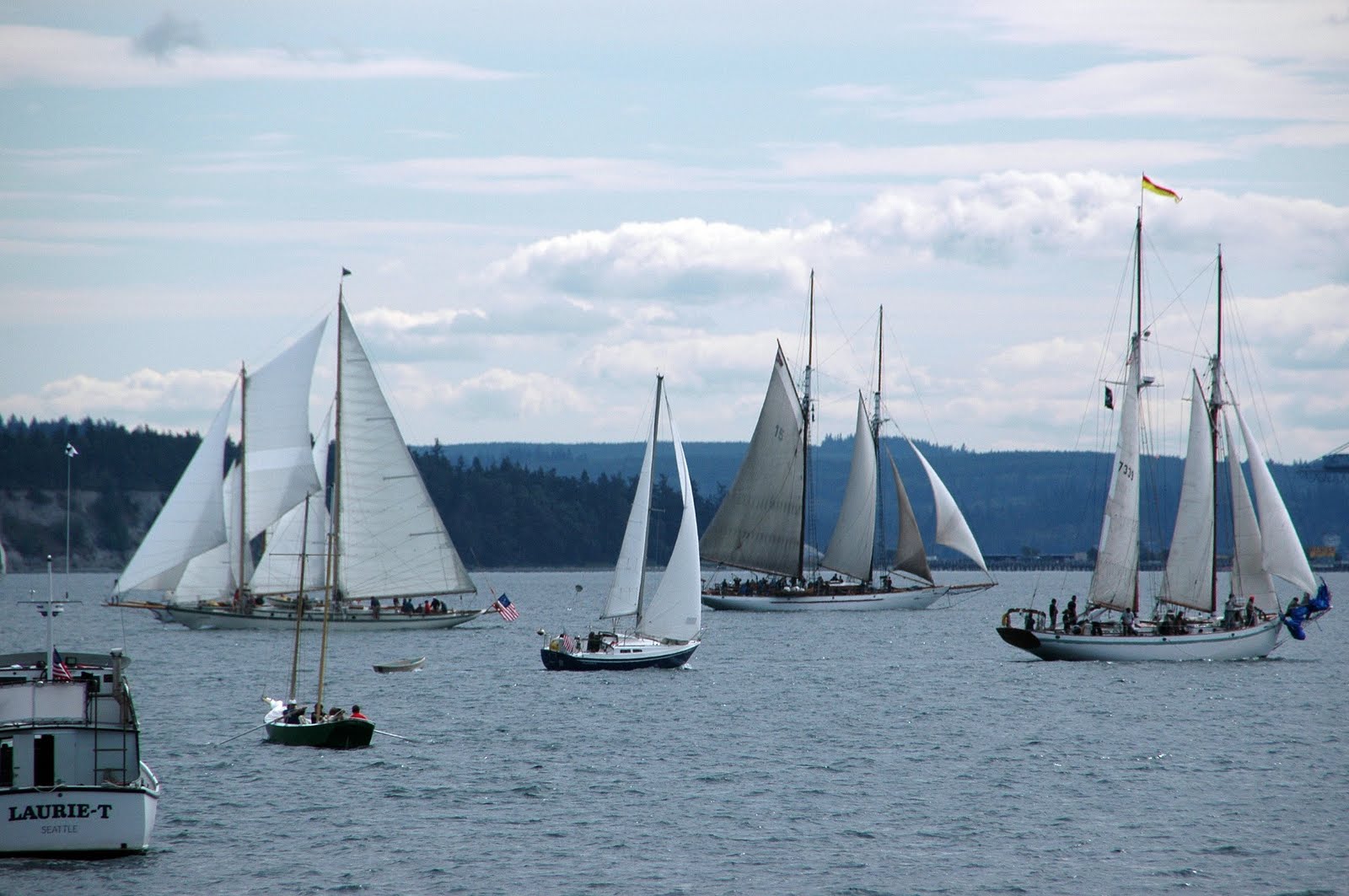
Just reminiscing today.
Doryman's first fixed keel boat Scud was for up sale at the first
Port Townsend Wooden Boat Festival. It was a hardy looking little boat with a simple cabin and it was love at first sight. Doryman had been teaching himself sailing for a couple years, so knew next to nothing about sailing, boat design, or how to buy a boat. Ignorance is bliss, as they say! It was a happy marriage. Scud was a Picaroon and fortunately, for our intrepid sailor, was practically indestructible. The first night aboard, just about a mile south of Port Townsend, an odd scrapping noise woke our hero who jumped up to find he could see the rocks of the sea bottom in the faint light of the moon. Navigating by dining table place mats made from old charts, disaster was narrowly avoided (not the last time!) Oh, the folly of youth!
It's time to acknowledge the genius of Sam Rabl. Here is what the man himself has to say about his Picaroon (scroll through the alphabetical index on the last link; there's a lot of good stuff there):
"Picaroon is that same little boat that Brice Johnson built for me in Cambridge over thirty years ago, the same boat in which Hank Hemingway had his great adventure in the Gulf of Mexico, sailing from Mobile to Neuvitas in Cuba. The same tabloid cruiser of which Westy Farmer wrote: “A delight to the eyes of every sailorman,” and to which the late Charles Hall attached the title of the “Perennial Picaroon”. She is the same little ship that was destined to become world-famous and to have been built on every continent of this globe."


"Modern methods of construction have afforded some improvement in her construction but have detracted not a whit from her seaworthy lines. Plywood has produced a better hull, there is no reason why she cannot still be built with main frames of 11/8” x 3¼”, and intermediates of 11/8” x 2¼” on 12” centers. The chine, sheer and bottom stringers would be 11/8” x 2¾” and the planking of 1” dressed material which will measure 13/16”. For this reason the lines are drawn to the outside of the planking. All pieces of the backbone are detailed so that no lay down is necessary. The keel, stem and all parts are assembled and set right-side-up on a keel horse. The frames are erected and braced and the stringers run in. By this time the reader has become familiar with the methods used in constructing other boats in this book so a detailed step-by-step instruction would be senseless. The frames are a combination of oak and plywood and form bulkheads and partial bulkheads as they are assembled in the boat. Properly fabricated, it is possible to assemble them in such a manner as to eliminate over 75 % of the interior work. Even the motor beds are detailed for pre-fabrication so that they may be assembled along with the frames. If you have a little knowledge of lofting it is also possible to pick up from the body plan the shape of such flat surfaces as the berth tops and cockpit flooring and fit these items before the planking is applied. Make extensive use of Elmer’s Glue and patent nails in all the assemblies. The motor fitted is a Universal Blue Jacket Twin. This motor develops 12 H.P. at full speed and is thoroughly reliable. While it has more power than is needed it will not be overstrained to maintain cruising speed. It also has electric starting which is a must in most single-handed work. Electric starting gives the added advantage of power for lighting and an automatic bilge pump. The cabin arrangement is primitive. The head is an ordinary galvanized pail with a homemade Johnnie seat to cover it and make its use more comfortable. The galley is self-contained and built around a G.I. Coleman stove and which may be stowed anywhere that loading conditions may permit. Inflatable beach mattresses will work well on the berths, and for clothes stowage there is nothing better than the traditional sea bag which still exists in our atomic Navy much in the same form that it did on Old Ironsides. The sailing rig is much the same as I used with complete success on my last little auxiliary, the Meg. The loose-footed sail permits brailing against the mast without lowering, keeps clean in this way, and removes the temptation to soil it with hands slimy from fish or bait if it were stowed on the boom. One thing that I would personally carry would be a combination sail with slides on one edge and jib snaps on the other, and which would serve the double purpose of either storm jib or storm trysail as occasion would demand. Both the mast and boom are hollow spars built up from lumber and plywood and should present no difficulties. The outside ballast may be a weldment or a casting, either of which will cost about the same unless you have a friend who is familiar with acetylene cutting and arc welding. The original Pic carried all of her ballast inside and this boat will do the same if you wish to eliminate the weighted keel. Still another alternative is to cast the keel in concrete, filling in as much lead or iron scrap as the aggregate will permit. In this case it will be well to cap the entire keel bottom with two pieces of 1” x 3” flat iron bar and weld the lower ends of the keel bolts to this as well as tack-welding the two bars together. This iron alone will weigh about 40 pounds per running foot and will be down where it will do the most good. A good coating of Rustoleum paint on all of the iron work will eliminate a lot of corrosion."
Old fashioned construction with old fashioned virtues! Sam had it right. The Picaroon would not win a race, except against another Picaroon, but a stronger, more resilient boat would be hard to find. Doryman's Scud had a simple cutter rig that was easy to tend and forgiving of the grossest error.
Hats off to Sam! May his designs live forever and inspire many more generations.
.