Showing posts with label Building Mistral. Show all posts

Thursday, November 23, 2017

Meditation and Transformation


It's quiet here today. I just returned from a walk with the dog. She's the offspring of a spirited Border Collie, bred with a Blue Healer. She doesn't care much for calendars or clocks, and lives from moment to moment, the all too infrequent romp in the woods. I strive to be more like her.
Heather left long before daybreak, to work at the bakery, serving the gluttonous masses. In silent meditation, I've decided to fast in contemplation. I live in a country so preposterously prosperous that being thankful for good fortune seems hypocritical.
The rain comes down in buckets, as we say, out in the boatyard, and though I spend most days out there working in all weather, it seemed appropriate to set the tools aside for awhile. In a bit, I'll go out and bail an old carvel-planked boat that is kept open to the weather, to keep her planks swollen and tight. Her other, more protected sisters will be patted down and reassured their lives will not always be spent on the hard. My neighbors see this ritual as tedious, but I do not - it is a meditation for a sailor between voyages. It is said the professional sailors of old yearned for the sea the day they returned home. I once knew an old fisherman who, while in port, would visit his boat everyday and sit at the helm, reading and listening to the marine broadcasts. I can relate.

Remember Mistral, the big live-aboard/cruising dory that inspired the moniker on the header? She is still around, though an apparent permanent resident of the backyard boatyard. We hauled her from the water a couple years ago to make the journey from the Oregon coast to my new domicile in Port Townsend. Why didn't I sail her here on her own bottom? You ask a good question. The best answer I can offer, is, a trip northbound on the Pacific coast of the US is strenuous, since a vessel must climb uphill, against prevailing weather and tide. I've done it a few times - and failed, too. It's not a voyage to be taken lightly.

A vessel must be redundantly reliable for an open ocean passage.
Mistral suffers a limitation due to poor design and it's nobody's fault but mine. (Oh how hard it is to say that...). I gave a lot of thought to accommodations, structure and sail rig, but just let the cockpit and steering happen on it's own.


Over the years (how quickly they pass), I have struggled with different steering options, going from a simple tiller, to a wheel, and when that failed, back to a tiller. The hard truth is, on a double-ended vessel, the cockpit can be pitifully tight.


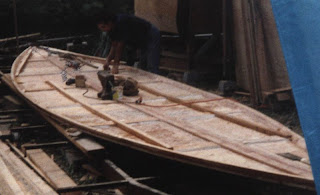
So, deciding to finally do something other than going from one haphazard solution to another, Mistral's surgery has begun. First, I've taken a hardtop bimini from an older boat and covered the helm seat. Next, I sawed the old transom off. You heard me right. The languid angle of a dory transom is simply too low for a stern mounted rudder. In a tack, the rudder lifts to the surface of the water, losing purchase and the unfortunate vessel stalls. If the dory doesn't have enough weigh, it is soon in irons. I could have designed a balanced rudder, but am disinclined toward underwater holes in my boats. So now, Mistral's stern is more vertical. I really love the diminutive V shaped transom of a traditional dory, so this was a hard choice. The change is not severe, in an attempt to keep that aesthetic.


To add more seating for the helmsman, I've taken liberties suggestive of traditional Asian sampans. Since I usually sit up on a very skinny shear rail while under sail, I've added a platform, up under the bimini, which my friend Martin calls the poop deck.

I apologize for the poor quality of these photos. Like I said earlier, the winter monsoons have arrived, which means, if I'm to get any time in the boatyard, I must work under a tent.


 Meditation and transformation to keep a sailor sane, while ashore.
Photo courtesy of Mathew Atkin

Friday, September 16, 2011

Live-aboard Dory


DoryMan has been receiving visits from a discussion on the WoodenBoat Forum lately on the subject of St Pierre Dories and live-aboard dories in particular. But the Forum will not allow me to respond. Imagine that.

So, this is for you folks who come here looking for information on dories. Mistral is my own dory-cruiser and a fine live-aboard she is. She is my own design and I built her (by) myself. She is 36 feet LOA with an eleven foot beam and displaces five tons. For those contemplating such a task, let me warn you - it will take a lot of energy, time and commitment. At times, I was on the verge of cutting Mistral up for firewood.


But to live your dreams is worth every minute. In fact, I am convinced there is no other way to live. That's why I write this blog - to encourage others to live their dreams. It does not matter if you don't know what you are doing - you will learn.


Mistral is not a St Pierre Dory, but similar. Her bottom profile is flatter, which gives a comfortable walking area below (the St Pierre has the most severe bottom rocker of all the dories and walking around in one can be a challenge). For those who are contemplating building a St Pierre, we have been following two different stories this last year, click here.


You are encouraged to add to the comments at the end of this post (or any post - I love to talk about boats!) Or contact me: mbogoger(at)gmail.com if you have a story to share.


Images of Mistral under sail can be found here.
.

Tuesday, February 2, 2010

Mistral's New Mains'l


It's been twenty years since the inception of the dory cruiser Mistral. She's been afloat for almost five years. Last weekend marked the completion of the design.

That's a long time. Thinking back at all the things that have happened in those years, both personally and over the world, it's a completely different place. There were times when this big dory was a burden, an unfinished hulk... Almost chainsawed it into scrap twice.


But more than anything, it's been good therapy.

For the last five years the sail rig has taken shape organically. Starting with a salvaged mast and used sails and ending recently with a new custom made mainsail. After weeks of hand sewing finish details, the sail was ready for a test on Sunday last. The crew showed up, the sun came out from behind the clouds and we went sailing.

There was no wind to speak of, but opportunities came and went for checking the set of the canvas and the drive of the ship. Snacks and champagne (Chuck brought his prize winning smoked salmon!) were passed around the cockpit. Therapy indeed!


My good friends Kim and John came out in their skiff and took photos. Kim is just learning to use her camera and she has an excellent eye. Thanks, Kim!


And thank you Chuck and Rick and Shay and Mary for excellent camaraderie, good food, hard work and helpful design improvement suggestions!

Mistral on the River from doryman on Vimeo.


I'd also like to thank all of you who have offered encouragement and interest in this project, since the beginning of this blog. The idea behind this journal was to document Mistral and her cousins and it has turned into so much more.

It's been a blast!
.

Sunday, July 5, 2009

Mistral Design Revisited


There are a few nascent dory designers who have written to me with comments and questions about designing and building Mistral, so I’d like to talk about that in a little more detail, hopefully answering some of those questions. (The rest of you, please humor me…)


There are no plans on paper for the build of this boat -- I think you can get by just fine without true plans, because the dory is a simple boat that has changed very little in centuries and is tried and true. And before there was paper, the plans filtered down through generations by word of mouth and trial and error.

I think of wood boat building as sculpture. Each piece made in the process has to fit in complete harmony with every other piece, so it's essential to visualize the entire piece from the very start. Wood carvers will tell you that the material they are using defines the sculpture. Despite the mathematical rigor in boat design, every hand made boat is different from all others, even those made by the same person with detailed plans, since interpretation plays an essential part of the creation.
For me the design / build process is organic and develops in my head as the boat is built. The proportions of dories can be found in a variety of sources, but the boats are remarkably similar. For this reason I was confident, though I had never seen a dory as big as Mistral, the proportions from an existing table of offsets for a banks dory would translate smoothly into the much larger boat I imagined.
If you are drawing your own plans and feel intimidated about details, take heart! Jump right in, the details will work themselves out.

I don’t mean to imply that the boat built itself. There was a year of pondering and engineering to work out the scantlings and when in doubt, I erred on the side of overbuilding. Mistral utilizes modern truss framing and plywood for strength so, though she is a stout boat, she still required additional ballast to carry sail.

The backbone is a keel built of laminated fir 2x6. For the forward half of the boat, this keel takes the shape of the rocker, but for the aft half, it has a flat bottom combined with rocker and so becomes deeper toward the transom.
How much rocker is needed? There is the St.Pierre et Miquelon which has a very jaunty chine and even livelier shear, and is an active boat, buoyant and agile, thus so the Mackenzie River Dory, which can turn on a wave crest. The bateau or flat bottom skiff has almost no rocker and is less fidgety. The eventual use will determine how active the bottom shape of your dory will be.


Mistral has about six inches of rocker fore and aft, and is relatively flat for boat with a 30-foot waterline. It’s just enough, and she cuts through the water like an eel.

She has straight frames with sheet plywood and was originally designed with a 3/4-inch bottom, 1/2-inch hull, 1/4-inch cabin sides and 3/8-inch decks (all marine grade fir plywood). The frames are (clear grained) old growth Douglas Fir 2x4's at 17 inches center to center. I didn't feel comfortable with the 3/4" bottom, so laminated another layer of 3/4" for a total of 1.5". I would recommend this, since the weight down low is good for stability, and a flat bottomed dory should be able to support it’s own dry weight.


Since Mistral is to carry sail, she needs ballast. The ballast is in a box, made of half-inch plywood, poured full of concrete, with several continuous lengths of steel reinforcing bar, for structural integrity. The ballast keel weighs one ton and is aligned with the middle section of the boat, which, for a double-ended hull is the approximate center of resistance. The finished keel is 18” deep, which gives the dory a total draft of 2.5 feet.

Stainless threaded rod bolts the ballast to the wood keel and epoxy impregnated 10-oz. fiberglass cloth covers the keel and hull. The motor is mounted off center, so there was no need to install a shaft through the keel. The weight built into the bottom vastly improves the handling of the dory.


Mistral has an 11-foot extreme beam, which means that on the road, I need a wide load permit and occasionally, pilot cars. Fortunately I don't trailer her much! She weighs five tons and about two tons of that is ballast. I added (one ton) interior ballast with the new mast, because she was very tender.


The dory is a very buoyant boat by nature and rolls quickly from side to side, which makes people nervous. Once you know the boat, this feeling disappears, because the design is incredibly seaworthy and will always right itself. You learn quickly to keep your weight centered. The hull will carry an impressive load --- an additional ton of ballast raised my waterline only 1.5"!

Mistral has "raised decks". In the pictures, the knuckle you see is the true shear and the beam of that basic hull is 10 feet. There is added width in the raised decks (an additional foot), which I designed primarily to help give me standing headroom without having a tall, boxy cabin. This feature became apparent during construction and is an example of how a plan will develop.
The beam at waterline is approximately six feet, which is a positive influence on efficiency, but contributes to lively response.

With Mistral’s low aspect sail, she goes like a greyhound on a reach or downwind, but with a full keel, she is slow to tack.
I run a 9.9 hp Mercury four-stroke “Sail Power” outboard in a motor well, which pushes the boat along at about five knots and is a testament to the efficiency of the double-ended dory hull. This oversized dory will cruise at this speed for 7-8 hours on a small three-gallon tank of fuel, with this small efficient motor.
A full sea trial is still in the future. I intend to petition my friends as crew. Any takers?

The mainsail I ordered for Mistral is still at the sailmaker's - I think I hit her at a bad time of year. So, I'm still using an old hand down main, which is too small for the boat. I recently adapted a used jib (Lashed on some hanks – That was fun!) which seems to work just fine (the one I had is now the storm jib). So things are improving. I made an up river run from the boat yard last week under jib alone (running with the tide) and averaged five knots! There was too much stuff (paint cans and etc.) to get the main out.


There is a great book about building the St.Pierre et Miquelon by Mark White, published in 1978 by International Marine Publishing. It is probably long out of print, but a real jewel. Mark builds a planked St. Pierre in Alaska (outside!) and documents it with pictures and a text intended for commercial fishing vessels. He recommends a 10 hp Saab or 10 hp Volvo Penta. He says the Saab has more torque, but the Volvo is much more economical.
To carry the weight of the inboard, Mark widened the transom eight inches, top and bottom, then fared that extra width forward to just past amidships. This added buoyancy and stability in the stern.


I wish I had widened my transom a little, too. I love the double-enders, but the cockpit is narrow just where I need the room for jib sheets, main sheet traveler and such. With the motor well in the cockpit, my big boat has the working room of a much smaller vessel.


There are design changes going on in my head all the time. If I were to build this boat again, it would look much different. But I won’t bore you today.

Please check links to other posts detailing the build of Mistral for additional information.

I’d be interested in hearing from others who are designing their own boats. The process involved is similar for all types of vessels and we can share comments and feedback.

Tuesday, November 4, 2008

Building "Mistral"


In 1990, I started building a 36 foot dory. It has been a long process, with many shifts in priorities, but the boat is finished and is the inspiration for this blog.
SV Mistral was not originally intended to be a sailing vessel. The concept was a shoal draft, live aboard/ camping boat that would move efficiently through inland waters. The impetus to finish her as a sailboat came from friends who recognized the potential in this simple, efficient design. Though she has not yet been tested, she is more than an inland water camp boat, but a capable cruiser and comfortable liveaboard. In the eighteen years since the inception of this craft, I have designed, built, and restored many other boats, but none have given me so much. I couldn't begin to guess how many hours went into building this boat, but it was worth every minute. The next few postings will introduce an overview of building Mistral

Laying up the keel with the proper camber, or "rocker" is the first step. The first pictures in this set are scanned from old and faded photos, taken with a dusty, dirty shop camera. Bear with me?

The bottom takes shape


The dory is characterized by it's flat bottom, which creates a shallow draft boat. This thirty six foot boat, without ballast, draws slightly less than two feet. The finished boat, with two tons of ballast, draws less than three feet. The dory has an enormous amount of reserve buoyancy - this boat could carry something like twenty thousand pounds! Even with such a payload, it would be one of the most efficient designs on the water, requiring very little horsepower to make hull speed.
Note the keel, which is laminated of 2x6 fir.

Lofting; Full Sized


The dory design is defined by "stations". The stem and transom are the beginning and the end and in between are enough molds to give the boat it's shape. In this case, there is no plan and no molds. Every third frame set is built and fared to battens. After this, the intermediate frames are filled in. Mistral's frames are clear, vertical grain fir 2x4's. All the wood used in building this boat is locally acquired Douglas Fir. Call it my "indigenous" boat. The plan for this boat is in Doryman's head and takes shape for the first time as it is being built. A very old fashioned way of design/ building.

Decks and Beams


The deck beams are laminated redwood, very light and strong. The decks are made of 3/8 inch marine grade plywood and covered in epoxy impregnated fiberglass. The 'glass adds strength, durability, and superior weatherization.

Hull Sheathing


The "planking" is full sheets of one-half inch marine grade plywood. You have not lived until you have stressed a piece of plywood, covered in glue, over frames, upside down.

The Roughed-out Hull


She has no name yet, and is only the rough shape of things to come. Unknown at the time, my project would go into hibernation for a decade. Occasional progress was made over the next ten years, but life had other plans for Doryman.

Headed for the water


Several years later, in 2004, Mistral is ready to transport to the ocean. At this point she weighs about 8,000 pounds, and with a trailer that weighs almost a ton, the load has just about maxed out the capacity of Doryman's hard working truck! It's a good thing he has so much help!!
The trip to the coast is about one hundred miles over the Coast Range of mountains in western Oregon. A wide load permit is required, since Mistral has a beam of eleven feet. For half of the trip a pilot car is also required, so it's quite an event!

First Launch


An exciting day for Doryman as Mistral is lowered into the water for the first time. Since she is designed and built solely by Doryman, there is a fair amount of trepidation and anxiety about how this will turn out! Any boat builder will tell you that seeing their creation float for the first time is a huge relief!
Note the outboard in the motor well. Mistral's auxiliary power is a 9.9 hp Mercury "Sail Power". This is a small motor for a 36 foot, 5 ton vessel, but the hull shape is a very efficient one, and Mistral will make an honest five knots with this motor at two thirds power.

Fitting new tabernacle and railings


The spring of 2006 finds Mistral at the boat yard getting fitted out for a new mast tabernacle and a bright new paint job. 2000 pounds of interior ballast has also been added to offset the weight aloft from her intended wood mast. For anyone planning to launch their project before it's completed, I would advise against it! Working on a boat in the water and in boat yards is difficult, time consuming and at times, expensive. It's the proverbial three steps forward and two back!
.

Mistral gets her mast and rigging


"On the hard", Mistral is rigged for sail. The mast is set in a tabernacle on the leading edge of the main cabin and can be raised and lowered as needed. The lowered mast rests in a cradle on the stern of the boat. This picture was taken during Mistral's haul-out, the summer of 2007.
I call this design the "Pemaquid" after the promontory in Maine, the area where the successful design used in this boat was developed for the cod fishery. Dories were lowered from larger boats and propelled by one or two fishermen, at their oars, over the schools of cod on the Great Banks.
The sail rig is more the skipjack type with a very low aspect ratio. With a long boom and a full keel she will be slow in stays, but sea worthy as a Stormy Petrel.

Mistral, a Sail-Rigged Dory


The SV Mistral is a shoal draft cruising/live aboard. She has been a labor of love for Doryman for eighteen years. In this photo the completed vessel lies quietly at anchor on the Yaquina River in western Oregon, USA.