Showing posts sorted by relevance for query st pierre dory. Sort by date Show all posts

Tuesday, April 6, 2010

St. Pierre Dory


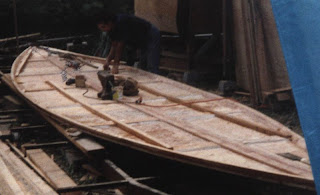
George Waite is a semi-retired ex-Naval Architect turned bridge engineer and the boat that he is building is a 21ft OAL St Pierre et Miquelon dory.

He abstracted the design from old black and white photos and built a 1:17 scale model. The boat was lofted directly from the model.


The construction is marine plywood with Iroko framing, and the engine is a 30 hp Yanmar diesel inboard.

He tells me that as a boy in Australia a St Pierre dory was used as a shipyard boat where his father worked and it was there that he first became familiar with dory handling.


George now resides in the UK and the day he sent me photos, it was snowing. Very pretty, but how do you build a boat in the snow?

Since George has trouble getting into small spaces (oh, don't I know that one!), he has opted to build in all of his systems before completing the hull. The planking will be the last step in this project.

It appears that the boat project has taken over his garden and an observant person might wonder how he is going to get it out of there... We are assured that those details have already been worked out and it will be a cake walk.

I suppose one could expect no less from an engineer. Thank you George - please stay in touch, we're all looking forward to seeing the finished St. Pierre et Miquelon on the water!

St. Pierre dories have high bows and sterns and a jaunty shear. They're named for the communes of Saint-Pierre and Miquelon, two islands in the rugged North Atlantic, off Newfoundland. The sturdy Basque fishermen of the area used these dories to work some of the most tempestuous waters on the planet, in the treacherous Cabot Strait.

The St. Pierre embodies seaworthy utilitarian elegance.

John Gardner documented the displacement grande dory, with detailed plans and building instructions, in his seminal "The Dory Book".
Another great resource is Mark White's "Building the St. Pierre Dory", first published in 1978.

While Gardener's plans are for traditional clinker construction, White's boats are strip planked.
John Gardner's book is still in print and George tells me that Mark White's book is available from on-line used book sellers.
Both of these fine books were instrumental in the development of my own Mistral. Great reading for boat builders and dreamers.
.

Friday, September 16, 2011

Live-aboard Dory


DoryMan has been receiving visits from a discussion on the WoodenBoat Forum lately on the subject of St Pierre Dories and live-aboard dories in particular. But the Forum will not allow me to respond. Imagine that.

So, this is for you folks who come here looking for information on dories. Mistral is my own dory-cruiser and a fine live-aboard she is. She is my own design and I built her (by) myself. She is 36 feet LOA with an eleven foot beam and displaces five tons. For those contemplating such a task, let me warn you - it will take a lot of energy, time and commitment. At times, I was on the verge of cutting Mistral up for firewood.


But to live your dreams is worth every minute. In fact, I am convinced there is no other way to live. That's why I write this blog - to encourage others to live their dreams. It does not matter if you don't know what you are doing - you will learn.


Mistral is not a St Pierre Dory, but similar. Her bottom profile is flatter, which gives a comfortable walking area below (the St Pierre has the most severe bottom rocker of all the dories and walking around in one can be a challenge). For those who are contemplating building a St Pierre, we have been following two different stories this last year, click here.


You are encouraged to add to the comments at the end of this post (or any post - I love to talk about boats!) Or contact me: mbogoger(at)gmail.com if you have a story to share.


Images of Mistral under sail can be found here.
.

Sunday, July 5, 2009

Mistral Design Revisited


There are a few nascent dory designers who have written to me with comments and questions about designing and building Mistral, so I’d like to talk about that in a little more detail, hopefully answering some of those questions. (The rest of you, please humor me…)


There are no plans on paper for the build of this boat -- I think you can get by just fine without true plans, because the dory is a simple boat that has changed very little in centuries and is tried and true. And before there was paper, the plans filtered down through generations by word of mouth and trial and error.

I think of wood boat building as sculpture. Each piece made in the process has to fit in complete harmony with every other piece, so it's essential to visualize the entire piece from the very start. Wood carvers will tell you that the material they are using defines the sculpture. Despite the mathematical rigor in boat design, every hand made boat is different from all others, even those made by the same person with detailed plans, since interpretation plays an essential part of the creation.
For me the design / build process is organic and develops in my head as the boat is built. The proportions of dories can be found in a variety of sources, but the boats are remarkably similar. For this reason I was confident, though I had never seen a dory as big as Mistral, the proportions from an existing table of offsets for a banks dory would translate smoothly into the much larger boat I imagined.
If you are drawing your own plans and feel intimidated about details, take heart! Jump right in, the details will work themselves out.

I don’t mean to imply that the boat built itself. There was a year of pondering and engineering to work out the scantlings and when in doubt, I erred on the side of overbuilding. Mistral utilizes modern truss framing and plywood for strength so, though she is a stout boat, she still required additional ballast to carry sail.

The backbone is a keel built of laminated fir 2x6. For the forward half of the boat, this keel takes the shape of the rocker, but for the aft half, it has a flat bottom combined with rocker and so becomes deeper toward the transom.
How much rocker is needed? There is the St.Pierre et Miquelon which has a very jaunty chine and even livelier shear, and is an active boat, buoyant and agile, thus so the Mackenzie River Dory, which can turn on a wave crest. The bateau or flat bottom skiff has almost no rocker and is less fidgety. The eventual use will determine how active the bottom shape of your dory will be.


Mistral has about six inches of rocker fore and aft, and is relatively flat for boat with a 30-foot waterline. It’s just enough, and she cuts through the water like an eel.

She has straight frames with sheet plywood and was originally designed with a 3/4-inch bottom, 1/2-inch hull, 1/4-inch cabin sides and 3/8-inch decks (all marine grade fir plywood). The frames are (clear grained) old growth Douglas Fir 2x4's at 17 inches center to center. I didn't feel comfortable with the 3/4" bottom, so laminated another layer of 3/4" for a total of 1.5". I would recommend this, since the weight down low is good for stability, and a flat bottomed dory should be able to support it’s own dry weight.


Since Mistral is to carry sail, she needs ballast. The ballast is in a box, made of half-inch plywood, poured full of concrete, with several continuous lengths of steel reinforcing bar, for structural integrity. The ballast keel weighs one ton and is aligned with the middle section of the boat, which, for a double-ended hull is the approximate center of resistance. The finished keel is 18” deep, which gives the dory a total draft of 2.5 feet.

Stainless threaded rod bolts the ballast to the wood keel and epoxy impregnated 10-oz. fiberglass cloth covers the keel and hull. The motor is mounted off center, so there was no need to install a shaft through the keel. The weight built into the bottom vastly improves the handling of the dory.


Mistral has an 11-foot extreme beam, which means that on the road, I need a wide load permit and occasionally, pilot cars. Fortunately I don't trailer her much! She weighs five tons and about two tons of that is ballast. I added (one ton) interior ballast with the new mast, because she was very tender.


The dory is a very buoyant boat by nature and rolls quickly from side to side, which makes people nervous. Once you know the boat, this feeling disappears, because the design is incredibly seaworthy and will always right itself. You learn quickly to keep your weight centered. The hull will carry an impressive load --- an additional ton of ballast raised my waterline only 1.5"!

Mistral has "raised decks". In the pictures, the knuckle you see is the true shear and the beam of that basic hull is 10 feet. There is added width in the raised decks (an additional foot), which I designed primarily to help give me standing headroom without having a tall, boxy cabin. This feature became apparent during construction and is an example of how a plan will develop.
The beam at waterline is approximately six feet, which is a positive influence on efficiency, but contributes to lively response.

With Mistral’s low aspect sail, she goes like a greyhound on a reach or downwind, but with a full keel, she is slow to tack.
I run a 9.9 hp Mercury four-stroke “Sail Power” outboard in a motor well, which pushes the boat along at about five knots and is a testament to the efficiency of the double-ended dory hull. This oversized dory will cruise at this speed for 7-8 hours on a small three-gallon tank of fuel, with this small efficient motor.
A full sea trial is still in the future. I intend to petition my friends as crew. Any takers?

The mainsail I ordered for Mistral is still at the sailmaker's - I think I hit her at a bad time of year. So, I'm still using an old hand down main, which is too small for the boat. I recently adapted a used jib (Lashed on some hanks – That was fun!) which seems to work just fine (the one I had is now the storm jib). So things are improving. I made an up river run from the boat yard last week under jib alone (running with the tide) and averaged five knots! There was too much stuff (paint cans and etc.) to get the main out.


There is a great book about building the St.Pierre et Miquelon by Mark White, published in 1978 by International Marine Publishing. It is probably long out of print, but a real jewel. Mark builds a planked St. Pierre in Alaska (outside!) and documents it with pictures and a text intended for commercial fishing vessels. He recommends a 10 hp Saab or 10 hp Volvo Penta. He says the Saab has more torque, but the Volvo is much more economical.
To carry the weight of the inboard, Mark widened the transom eight inches, top and bottom, then fared that extra width forward to just past amidships. This added buoyancy and stability in the stern.


I wish I had widened my transom a little, too. I love the double-enders, but the cockpit is narrow just where I need the room for jib sheets, main sheet traveler and such. With the motor well in the cockpit, my big boat has the working room of a much smaller vessel.


There are design changes going on in my head all the time. If I were to build this boat again, it would look much different. But I won’t bore you today.

Please check links to other posts detailing the build of Mistral for additional information.

I’d be interested in hearing from others who are designing their own boats. The process involved is similar for all types of vessels and we can share comments and feedback.

Thursday, September 23, 2010

St. Pierre Dory


When we last visited George Gosselin in Ottawa, Ontario, Canada, he had found an old St. Pierre dory in the bushes and hauled it home. It's a great story.


George is working on this boat outside, so the winter weather in Ottawa determines the length of the season for reconstruction.


He also has distractions. This summer he was focused on restoring a 1960's 18 foot Wykes guide boat.

That's a pretty little skiff, George!


I don't know much about this boat, maybe George will fill us in. Apparently they are popular fishing skiffs on small lakes in Ontario.


The St. Pierre has not been neglected. George moved it closer to his house and turned it over to begin work on the decks and cuddy cabin. He hasn't settled on a cabin design yet. We've had some conversation about it and he's picked up some very good reference materials. I have a lot of confidence in this man. He'll do a great job I'm sure...


(More photos of George's project.)


Stay tuned!

Monday, January 2, 2012

Alaska Dory Fishing


Time and again stories surface that distinguish the humble dory as a historically significant boat. A faithful reader named Michael contacted me recently to share his passion for these simple boats. It’s always good to hear stories of how well a dory has served its owner, often against odds. The setting for this story is the yet untamed wilderness of Alaska, in the 1970’s, when young adventurers arrived with dreams of becoming wealthy salmon fishermen.

Michael begins his tale:

“My first dory was by Grunwald of Aeolus Boatworks in Davenport, CA. It was built to the lines of the Higgins and Gifford Dory in Chappelle's American Small Sailing Craft.”


“I took it to Alaska on a boat trailer in 1972 and it's still there. A couple of youngsters made an extended camping trip in her a couple years ago but she's too far gone to be trustworthy now.”

“The plywood planks are lapped and are backed by full-length battens inside, very strong construction. I can't begin to describe how horribly I mistreated that boat in Alaska. It lived the life of a neglected livery boat most of the time. She also transported deer and packed water to a winter cabin. That dory enabled a safe subsistence lifestyle in a very remote place.”

“I used to row this dory on San Francisco Bay, often crossing at night. I picked up birds during an oil spill, in 1971.
In 1972 I towed the boat on her trailer to Haines, Alaska then by ferry to Juneau, and then motored with a British Seagull engine to a small fishing village where I began my commercial fishing career.”

“After fishing the Gulf of Alaska for a couple years, I stashed the boat at a cabin on the outside coast and a trapper found her, enlarged the motor well to make room for a great big outboard, and then lost the boat.”

“I was in California at the time arranging financing to buy a commercial trolling boat when I got a call from the Coast Guard wanting to know if I was dead. It seems a Red Stack tug traversing the Fairweather Grounds with a double tow found the boat sunk and drifting. The skipper made a circle of a mile diameter and picked up the boat, taking her to Seattle, where I found her and arranged for passage back to SE Alaska on the deck of a tender.”

This hard working and long lived Higgins and Gifford Dory, shown above, beached on the rocks, now belongs to Omen Wild, a native Alaskan.
Photo is courtesy of Omen.


Michael continues:

“This is Raven, my current Grunwald dory. The flare angle is greater than any other dory I've measured. This makes her tiddly when light, but easy to row, even in a breeze.”

“I plan to close up the motor well, install water stowage, rig for sailing, and take on a long trip in the foreseeable future, possibly Puget Sound to Cross Sound in SE Alaska.”


Michael loves dories and has plans to build another (when he gets done with a couple kayaks he has in the works). This one will be a bigger cruising dory.

“The boat I currently dream of building is R.D. Culler's cowhorn dory, rigged with a balance lug yawl or junk sail, and set up like the Atlantic rowing dory boats for long distance cruising."
"I plan to make a planking model this winter. The cowhorn dory is on page six of Skiffs and Schooners. It is the size of a St Pierre but more moderate in rocker and sheer. She is very close to a 125% scale-up of Alfred Johnson's Centennial, which John Gardner documented in Wooden Boats to Build and Use, on page 53.”


Michael has been a visitor here for some time and I’m happy to finally make his acquaintance.

Welcome to the Doryman family, Michael! We’d really like to see that model when you’re done.
.

Sunday, February 17, 2013

Can Anyone Identify this Dory?

I've received a request from a reader to help identify the junk-rigged dory pictured below. I find this interesting cruiser familiar, but can't quite place her. The beach, composed of small rock and sand, lined with Douglas fir and soft maple trees is very characteristic of the Salish Sea (Puget Sound) in Washington state, US, but this is only conjecture.
If you have any information about this vessel, please leave a comment below, or send me a note at:
mbogoger(at)gmail.com

UPDATE
Today (2/19) a reader named Dan writes in to tell us:
"This dory on the beach is a creation by Victoria [British Columbia, Canada] artist Godfrey Steven. It's a St Pierre dory with bilge keels. The boat is now in the hands of Godfrey's daughter Aija on Salt Spring Island BC, Canada. The dory's name is Chu Wey."

Thank you, Dan!


Sunday, February 6, 2011

St Pierre et Miquelon Dory


In April last year we visited George Waite, in the UK, who is building a St Pierre et Miquelon dory.

George is a semi-retired ex-Naval Architect turned bridge engineer and the boat that he is building is 21ft LOA and barely fits in his garden. A recent inquiry about his project from a faithful reader prompted me to contact George to see how he is getting along.


Of course, the UK is experiencing one of the most violent winters in memory, so when I reached George he was sitting comfortably inside,sipping arrak with a visiting Turkish friend, while force 9 winds roared outside.

Wise man.


George assures me that he has managed to get some work done despite the weather. He feels he should be finished around August. He kindly sent me a photo in aerial view (taken from the roof?!) that shows him making up quick release battery cable connectors for removing the battery for regular storage/recharge and also installing the through-hull exhaust fitting for the 30 hp Yanmar diesel inboard.

He has completed most of the hull planking since our last visit but has cleverly left out a panel for easier access while installing the engine and accompanying systems.

His front garden looks a lot like a boatyard!

We wish George luck and hope to see his creation on the water next summer.
.

Sunday, September 25, 2011

Ulukhaktok Dory Ketch


Issuma is a 15m (50') steel staysail schooner with lifting keel, built by META in France to a Damien II design.

She has recently navigated the Northwest Passage from Whitehorse, Canada with a relatively ice free summer. Issuma has just completed the Bearing Strait, north to south. A fascinating story.


While they were in Ulukhaktok, Diamond Jenness Peninsula, Victoria Island, Canada, they came across the steel dory ketch Nur, which naysayers will note is a St Pierre Dory writ large.


Dan Johnson, I thought you in particular would appreciate this shot. Welcome aboard!
Looking forward to hearing more about the construction of your Badger.
.

Monday, May 10, 2010

The Story of the Dory


George Gosselin recently contacted me from Ottawa, Ontario, Canada to tell of a St. Pierre Dory he found. This project has resonance with me. How often have I walked into a project bigger than life and found that it was do or die?!

George tells a great story. I often paraphrase the notes I receive and sometimes edit too, but in this case to change anything would have lost the poetry of the narrative.

Hope you enjoy the tale as much as I do...

The story of the Dory
"This dory was Inspired from the book The Thousand Dollar Yacht, after reading this story Andrew Montief, the former owner got in contact with the Dory Shop in Lunenburg Nova Scotia, Lawrence Allen the owner then built the dory and it was the biggest one he could build because he couldn't get pitch pine planks any longer than 30 ft. and the widest one is 3/4in. x 14in.wide. The bottom made from pine 12in. x 1 1/2 in. splined the ribs made from tamarack or larch knees, it has a transom well and the tombstone is cut out on an angle to accommodate an outboard engine.
This all went together and was built in 1969 and was put into a train car in 1970 and shipped to Ottawa where Andrew and a friend of his trailered it back home to his work shop where he began to work on the deck and cabin cleats wheel and the engine steering components lites and a mooring bit, it was a work in progress for a few years. every year it was sunk for 2 weeks to take up water before the season and then leaked only a little."


"Andrew and his wife cruised in it down the St. Lawrence river to Montreal and back to Lake Ontario cruised extensively on Lake Ontario and the Redeu Canal made trips up the Trent Severn Canal System to Georgian Bay to Lake Huron and Back to Ottawa.
Andrew got sick and couldn't use the boat anymore and was in hospital for a while he ended up having to sell his home in the country and the boat went with the property.
some people had bought the property no one knew there was a boat back in there on the property nestled in the trees, covered in tarps."


"A friend of mine since past told me about this boat that some people he knew had this boat on their property and wanted to get rid of it, it had been there almost 9-10 years. not knowing anything about wooden boats he was advertising it for sale but no one would bite, just not the right part of the world, mostly farmers. If it had of been near the ocean I'm sure it would have gone right away."
"So my Buddy and I went over to check this boat out he knew i was wanting to either build the boat i had plans for or rebuild one. Well we went down into the dark woods about a 1/4 mile winding little bike trail and finally came across the Dory, well it didn't look like a dory just some moss wood and plastic and an old faded torn orange tarp and some sticks over top."
"Went over to the lump and pulled back the tarps and ok it had a hole in the stern climbed up and in and the moss growing on the gunnels and canvas decks was 2 inches thick."


"Got the door open and it was dark and scary looking inside the port lites were covered in mold and some moss was growing on parts of the plywood cabin interior. crawled in to the bow the floor looked ok, it had a head, two 7' benches and a small galley and a v-berth you could sleep 4 adults in this thing. there was a sump pump large one almost standing height."


"Went back out and started to poke at the planking and the bottom of the boat, seemed solid enough, but the paint on the planking was in really bad shape and made the boat look like it was totally rotten , there were some huge splits in each side running lengthwise on both sides in almost the same area just above the waterline for almost the entire length of the plank. well wasn't quite what i had in mind for a fixer upper. so we went home and i looked on the net to see if i could find out what kind of boat this was i spent a couple days of looking and finally found one, there was no mistaking the tombstone transom, although some of this one was cut off at the bottom to allow for the motor to be kicked up and prop wash and the bow and the rocker in the bottom and the sweeping curves of the gunnels flat bottom and wide flair of the sides."
"Well back to the boat we went to figure out how we are even going to get this 2 tons out of the bush.
There was enough room to just barely get the truck and trailer down to the boat after cutting a couple trees and there were sapling trees growing all round the boat.
I borrowed a flat bed trailer, Bud had some balsam poles he was using to move some logs around for his house and a 2 ton block and tackle.
we got the try pod set up and went up the ladder to put on the tackle 2 large straps around the boat and up and up slowly. the boat was sitting on 2 really large saw horses, so got them out of the way and backed the trailer under the boat and set it down slowly."
"Home we go. I agreed the give the gentleman a hundred dollars for it, instead of him burning it like he was threatening to do, met him at the top of the hill gave him his money, he was surprised we managed to get it out in one piece. got it home went back got the poles and ladder and lifted it and put it on blocks.
that was in 2007."


"Winter had set in and all i was able to do was to scrape some of the paint off and some of the trim off her and get it covered."
"Spring 2008 came finally that year and summer with lots of rain so I was limited on how much work I could do on her got some more paint, trim, cabin plywood off the decks and got the head and galley out then the floors which again were plywood saved all the hard wood that was it for that summer went fast but with not as much progress as i thought but the weather was bad and I couldn't afford a good enough shelter for her, so I tarped her over for another winter."
"Well spring 2009 here again well i better get this project going, we don't have to many summers left, if I'm ever going to get out on this girl.
so this year i decided that i needed to turn the boat over to get at the bottom paint and scrape the seams."
"So over the boat turns used the tripod again and some tires went over nice and easy, blocked it again. finished the scraping with scraper and heat gun.
The paint was on thick and the copper paint was the worst to take off a couple inches at a time, seriously wear a good mask the fumes are terrible!"
"Well now the paint is off and down to wood I've got the seams scraped and cleaned. some nails needed to be re clenched but i found that the planks cupped out a little and the plank seams are open a little now and clenching won't bring them back to make them tight. now for those splits in the planks the best fix for this is the replace the planks, well this is a really nasty process and almost impossible without replacing most of the planks. After searching and trying to find another way to fix this problem every where on the net, boat yards every one had there opinion, so many contradictions and no real answer i felt like i opened a can of worms from dolphinite to mixed epoxy to bondo. the split if not cut out would be a never ending problem, so i opted for the George Gosselin way. I used a tapered router bit and plunge cut a 2 inch hole around the split and round on the end of the split to keep it from traveling any further, i used the planks as a guide they were straight just made 2 different bases for the router. got the new pieces made and tapered edges couldn't get boards long enough so i scarfed 2 boards together one was over 21 feet and the other side was 18 feet got the CPES out and primed the seams then i mixed some epoxy and thinner s to make a thinner mix painted that on the edges that meet then mixed more without thinner and sanding dust from the palm sander, glued them in and screwed them to keep them from moving, filled holes and filleted the new pieces.
i put wood preservative on over the entire hull and let it dry for 2 weeks in the sun sucked and soaked rite in. got out the CPES again clear penetrating epoxy, great stuff but expensive gave to hull 2 coats then mixed up more epoxy thinned 2 coats of that sanding in between coats then 2 more coats not thinned.
sanding the entire hull


I decided to use sikaflex for the seams and small cracks in the laps too after a week it had set up and i sanded the hull again mostly the seams."
"Ah now the what paint to use here we go again the choices well needless to say you could put anything on and there would be someone saying you should have used something else but i take all words of advice seriously. some really good advise i have been given.
"I ended up using a 100% acrylic latex paint the most expensive i could find its a exterior bear porch and floor paint. I used the recommended primer as well 14 coats brushed on, not as nice as spray job but its not a Cadillac either its an east coaster and i wanted something that would wear off and not peel off."
"That's it for another summer, time to wrap it up for another year."


"Spring 2010, well another winter gone, was sort of short but i consumed more wood in the stove than in the past years. cut some new balsam poles and skinned them, they are 30 ft. 6 inch on bottom.
got them roped together, hammered in some stakes at the feet,to heavy to lift buy hand so i got them up as high as i could in the middle, then hooked on to them with the truck and raised them just waiting for some warmer weather now to rig the tarp for the summer season."


Best of luck to George! He's done a great job. He's planning to use a junk rig for it's sails or possibly a gaff rig with a tabernacle. The hull is repaired, painted and ready to be turned back upright.
The next step is to design and build a new cabin and George has asked for input. I made a couple of suggestions and I'm sure he would appreciate help from you, if you're so inclined...

To keep in step with George's progress, I will post updates to a Flickr set as George sends them in.